
 6 Jan 2026
Golang for Business: Core Benefits and Key Competitor Comparisons
Selecting the right backend architecture is a critical, high-stakes decision that directly dictates your product’s performance, infrastructure overhead, and engineering velocity. While legacy ecosystems often carry heavy technical debt, Google’s Golang (Go) has become a premier force for modern enterprise growth. This comparison breaks down why Go is increasingly preferred over industry staples like Java and Node.js. Our goal is to help you identify the optimal language to maximize scalability, minimize server costs, and accelerate your time-to-market.
Key takeaways
- High concurrency efficiency: Golang excels at handling thousands of simultaneous requests. It utilizes lightweight goroutines to process data-heavy tasks far more efficiently than Node.js or Java.
- Massive server cost savings: Thanks to its low memory footprint and compact compiled binaries, Go utilizes hardware with extreme efficiency. This setup allows businesses to slash monthly cloud and infrastructure bills.
- Rapid team onboarding: Go features a minimalist and intuitive syntax that eliminates complex boilerplate. This simplicity enables developers fluent in Java or JavaScript to achieve full production readiness in just two weeks.
- The cloud-native standard: As the foundational language behind industry standards like Docker and Kubernetes, Go is the premier choice for building scalable, containerized microservices.
- Faster time-to-market: Combining fast compilation speeds with easy-to-maintain code repositories, Golang significantly compresses development lifecycles. This agility accelerates feature deployment.
Why choose Golang for business development?
Golang has emerged as a top choice for business development because it was specifically engineered by Google to overcome older performance limitations. The language successfully addresses the scalability boundaries found in environments like Java and C++.
Exceptional performance & lightweight architecture
Its architecture is designed from the ground up for raw speed and hardware efficiency. This design makes it highly competitive for modern backend services and processor-intensive operations.
Compiled efficiency and speed
As a statically compiled language, Go executes significantly faster than scripting languages. Its compilation process produces compact, statically linked binaries. This engineering leads to near-instantaneous startup times and a radically reduced memory footprint.
Superior concurrency via goroutines
Go is considered a benchmark when it comes to concurrency. It utilizes goroutines paired with native channels. This architecture allows hundreds of thousands of processes to run independently and simultaneously without blocking one another. This model makes Go far more efficient than Java's traditional multithreading for demanding tasks like complex search algorithms or real-time data processing.
Golang produces remarkably small binary files, leading to faster container deployment cycles and reduced cloud storage requirements. Its low memory footprint allows businesses to handle higher volumes of concurrent traffic using the same hardware infrastructure. This capability translates directly into immediate cloud cost savings.
Automated memory optimization
The language features highly optimized, low-latency garbage collectors that automatically manage memory deallocation. This automated system prevents memory leaks and fatal bugs. This optimization ensures enterprise applications remain highly responsive even under unpredictable, peak traffic loads.
Seamless scalability & microservices mastery
For businesses planning for long-term growth, Golang offers a solid foundation for scalable, decoupled architectures.
Microservices perfection
Go is an ideal choice for microservices architecture, which involves dividing a complex legacy monolith into smaller, autonomous segments. Its low memory consumption and fast bootstrap times allow these independent services to communicate efficiently via API interfaces without lagging.
Cloud-native dominance
Golang has become the primary language of choice for modern cloud infrastructure. Major industry-standard tools, such as Kubernetes, Docker, Prometheus, and etcd, are all written natively in Go. This widespread adoption makes it the definitive standard for containerized, serverless, and cloud-based environments.
Elastic horizontal scalability
Because Go allows programs to be cleanly broken into semi-independent components, applications can be scaled or transformed horizontally with minimal engineering friction. This modular nature allows your core software infrastructure to scale elastically alongside your market expansion.
Faster time-to-market & lower maintenance costs
From a strategic business perspective, Golang significantly enhances engineering team productivity and reduces the total cost of ownership (TCO) throughout the entire software lifecycle.
Short learning curve and onboarding
Golang’s syntax is remarkably simple and intuitive. For engineering teams already fluent in Java or JavaScript, achieving production readiness in Go typically takes no more than two weeks. This rapid transition allows for exceptionally fast onboarding and immediate software delivery.
Streamlined code maintenance
Go programming language's strict focus on simplicity limits unnecessary structural choices. This strategy results in clean, uniform code repositories that are easier to debug and cross-maintain across different teams. Native testing frameworks and automated documentation tools further reduce manual intervention.
Fast compilation speeds and deployment simplicity lead to a significantly compressed time-to-market for new feature releases. Additionally, because Go is built for contemporary multi-core hardware, it requires far less complex configuration than older enterprise ecosystems.
Measurable infrastructure savings
Businesses can significantly slash their monthly cloud server expenses due to Go's lightweight resource utilization. Global companies like Uber, HelloFresh, and Brainly have already successfully leveraged these exact performance benefits. These transitions allowed them to create high-efficiency backend ecosystems that maximize capital ROI.
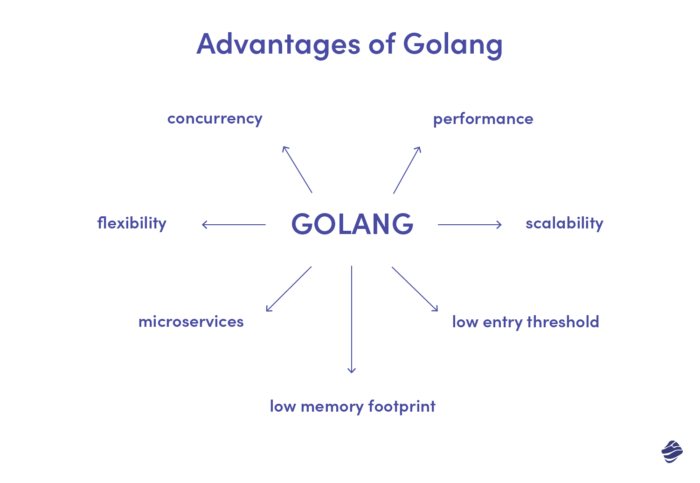
Golang vs. Java: Choosing the Right Enterprise Backend
Originally engineered by Google to overcome the legacy limitations of Java, Go has evolved into a foundational cornerstone for modern cloud-native application architectures. While both ecosystems are powerful solutions for enterprise-grade software, they address scalability, performance, and maintenance overhead from fundamentally different architectural standpoints.
Despite their architectural differences, Go and Java share critical foundational strengths that make them ideal for enterprise operations. Both languages offer excellent cross-platform support, ensuring that code runs seamlessly across diverse infrastructure environments.
Additionally, both feature automated memory management via highly optimized garbage collection mechanisms. While Java relies on the time-tested garbage collectors of the Java Virtual Machine (JVM), Go incorporates a modern, low-latency garbage collector designed to push pause times to sub-millisecond levels. This shared focus on automated memory management prevents critical memory leaks and ensures high runtime reliability without manual engineering intervention.
Where Golang wins: Built-in concurrency & cleaner code
Go outperforms Java when it comes to high concurrency and structural simplicity. Instead of Java’s heavy, OS-level multithreading framework, Go natively utilizes lightweight "goroutines" and built-in channels. This allows hundreds of thousands of asynchronous processes to run simultaneously without blocking execution paths, making Go an excellent choice for data-heavy calculations and real-time processing.
Furthermore, Go’s minimalist syntax eliminates complex enterprise features like class inheritance or method overloading. This omission delivers clean, uniform code that is easy to maintain across large engineering teams. Combined with fast compilation times and compact, statically linked binaries, Go ensures near-instantaneous container startup times and a radically reduced memory footprint.
Where Java holds ground: Mature ecosystem & standardized tooling
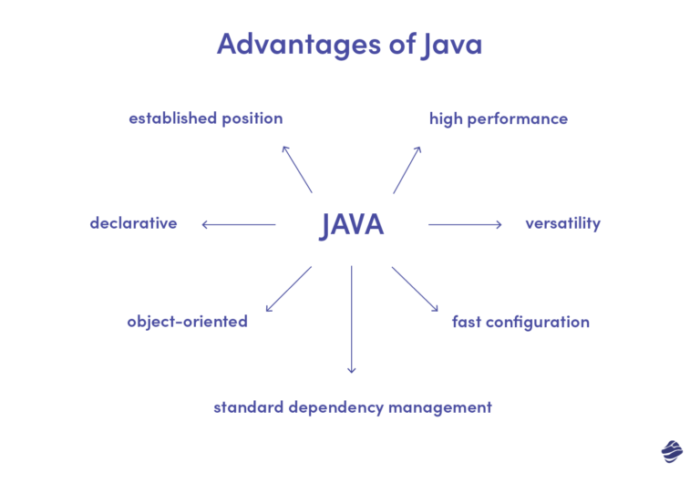
Java maintains a distinct competitive edge through its incredibly mature, multi-decade ecosystem and robust, standardized tooling. Enterprise systems built on Java benefit from a massive universe of battle-tested libraries, comprehensive documentation, and powerful frameworks like Spring Boot.
Java's tooling infrastructure, supported by deep dependency management platforms like Maven and Gradle, simplifies complex CI/CD pipeline automation and enterprise security configurations. While the JVM introduces higher initial memory overhead and slower container warm-up times, its Just-In-Time (JIT) compilation provides stability and continuous runtime optimization for long-running, massive monolithic legacies.
When should your business switch from Java to Go?
Java or Golang? Transitioning your enterprise infrastructure from Java to Go becomes a highly strategic, high-ROI move under specific operational conditions:
Fast performance due to Go's simplicity: Java developers can typically achieve production fluency in Go within just two weeks due to its simple syntax, immediately cutting onboarding overhead and compressing your time-to-market.
Migrating to microservices: Go’s minimal resource consumption and fast bootstrap times make it the textbook choice for breaking down heavy Java monoliths into highly efficient, independently scaling microservices.
Scaling cloud-native infrastructure: If your business heavily relies on modern containerized setups, Go eliminates JVM-related overhead. Since DevOps cornerstones like Docker and Kubernetes are built in Go, migrating ensures native, zero-overhead execution in cloud environments.
Cutting cloud expenses: Go utilizes hardware resources with extreme efficiency. Switching allows you to host significantly more concurrent users on the exact same server infrastructure, driving predictable and immediate cloud savings.
Golang vs. Node.js: The Ultimate Web Development Battle
While Node.js remains a dominant force in web development, Golang is increasingly preferred for modern projects requiring high performance and specialized concurrency model execution.
Architecture: Compiled Go vs. Node.js event loop
Go operates as a statically compiled language, converting source code directly into machine-readable binaries before execution. This native compilation allows Go to run significantly faster than scripting environments like JavaScript, which require an interpreter. Go intentionally eliminates complex features such as class inheritance to maintain structural simplicity.
In contrast, Node.js relies on a single-threaded runtime environment using a continuous event loop. While highly efficient for managing non-blocking Input/Output operations, the system can face architectural challenges when the internal queue of events grows too long. This bottleneck potentially slows down overall processing speeds.
Performance: Handling processor-intensive workloads
Node.js stands out as an excellent choice for I/O-intensive applications, including real-time messaging servers or streaming platforms, where the system does not need to wait for a server response. However, Node.js is not the best fit for heavy data calculations. Its single-threaded nature limits its ability to process massive workloads simultaneously.
Conversely, Go is exceptionally well-suited for managing high concurrency. Its goroutines execute multiple, heavy processes completely independently of one another without blocking the main thread. This parallel computing capability makes Go far superior for processor-intensive operations, such as multi-layered search algorithms or intensive data processing.
Cost & talent: Full-stack JavaScript vs. specialized performance
For many startups, Node.js represents a highly cost-effective initial choice. It empowers engineering teams to utilize JavaScript across both the frontend and backend, reducing early development budgets.
On the other side of the spectrum, Golang offers significant long-term operational savings. Go's exceptionally low memory footprint allows a single application instance to handle significantly more concurrent users on the same hardware. This efficiency drastically reduces monthly cloud costs.
Summary: Which backend language fits your next project?
The final choice should always align with your specific technical requirements and project scope. Ultimately, your roadmap dictates the stack. Choose Golang to slash server bills and maximize concurrency, Java for absolute enterprise stability, or Node.js to achieve rapid full-stack deployment.
Ready to scale your backend infrastructure?
Don’t let the wrong tech stack bottleneck your growth. Choosing the right backend language is the foundation of a reliable, cost-effective digital product. Making the right call today prevents costly refactoring tomorrow. Partner with Miquido to evaluate your architecture, optimize your infrastructure, and engineer a high-performance backend that accelerates your business goals.
Let’s discuss the perfect tech stack for your project today.
Is Golang definitively faster than Node.js and Java?
Yes, Golang outperforms Node.js in processor-intensive tasks because it is a compiled language, whereas Node.js relies on a single-threaded interpreter. Compared to Java, Go offers faster startup times and a much lower memory footprint due to its small, statically linked binaries. However, Java can match Go's speed in long-running enterprise applications thanks to mature Just-In-Time (JIT) compilation. Ultimately, Go remains highly efficient for high concurrency via lightweight goroutines.
How difficult is it for an existing dev team to switch to Go?
The transition is remarkably easy. Go features a minimalist, highly readable syntax designed to eliminate friction-heavy concepts like class inheritance. For software development teams proficient in Java applications or JavaScript, reaching full production fluency typically takes less than two weeks. This short learning curve minimizes onboarding overhead and allows developers to deliver value almost immediately while naturally enforcing clean, standardized repositories.
Can Node.js and Golang be used together in the same project?
Absolutely. Combining them within a microservices architecture allows businesses to leverage the unique strengths of both ecosystems. In this setup, Node.js effectively manages user-facing interfaces and real-time, I/O-intensive services where rapid frontend synchronization is required. Meanwhile, Golang handles the backend heavy lifting, including data-heavy processing, complex algorithms, and cloud-native scaling.

Top AI innovations delivered monthly!
The administrator of your personal data is Miquido sp. z o.o. sp.k., with its ... registered office in Kraków at Zabłocie 43A, 30 - 701. We process the provided information in order to send you a newsletter. The basis for processing of your data is your consent and Miquido’s legitimate interest.You may withdraw your consent at any time by contacting us at marketing@miquido.com. You have the right to object, the right to access your data, the right to request rectification, deletion or restriction of data processing. For detailed information on the processing of your personal data, please see Privacy Policy.


