
 18 Mar 2026
 17 min read
![[header] mobile app security best practices 10 essential tips for 2026](https://www.miquido.com/wp-content/uploads/2026/03/header-mobile-app-security-best-practices-10-essential-tips-for-2026-2048x1365.jpg.webp)
API-first architectures and AI integrations have pushed the primary security boundary directly to client devices and third-party services. Traditional perimeter firewalls cannot stop client-side binary decompilation or API authorization bypasses. They also fail to prevent data leakage through large language models. At the same time, regulatory frameworks like NIS 2, GDPR, and SOC 2 enforce strict operational accountability.
Our guide provides technical decision-makers with an operational security roadmap. It covers concrete methods for hardening mobile binaries and securing API endpoints with zero-trust protocols. Additionally, it details building external guardrails around AI components to preserve system integrity without slowing down production deployments.
Key takeaways
- Shift-left testing: Running automated security checks early in the SDLC reduces engineering costs. Executing these checks inside CI/CD pipelines prevents high-risk vulnerabilities from reaching production.
- Client-side binary defense: Protecting native mobile applications requires active runtime self-protection (RASP), multi-layered code obfuscation, and zero-trust local storage anchored to hardware-isolated enclaves.
- Core API controls: Securing data in transit and at rest demands TLS 1.3 and mobile certificate pinning. It also requires FIDO2 passkeys and short-lived, role-based tokens (OAuth 2.0 / RBAC).
- AI surface protection: Integrating LLMs introduces non-deterministic risks such as prompt injection and context window leakage. Managing this requires dedicated validation layers and real-time payload sanitization.
- Regulatory compliance: Adhering to standards like GDPR, HIPAA, NIS 2, and SOC 2 mitigates non-compliance penalties while satisfying enterprise vendor requirements.
Building a security-first development lifecycle (SDLC)
Security must function as an architectural requirement rather than a final gatekeeping check. Addressing threat models during initial system design lowers engineering overhead. Retrofitting security controls into established codebases requires far more resources. Building resilient architecture from day one avoids this overhead.
Shifting Left: balancing functionality and security
The Shift Left approach integrates security reviews directly into every phase of the agile development workflow. Rather than delaying security testing until pre-production, engineering teams evaluate risks during backlog refinement and architectural design.
To balance user experience with system defense, technical teams must evaluate their specific threat surface early in the SDLC:
- Threat modeling: Identify high-probability attack vectors unique to the industry, tech stack, and data sensitivity levels before writing code.
- Architectural guardrails: Select frameworks and libraries that natively enforce memory safety, automated query parameterization, and secure context handling.
- Risk mitigation costs: Evaluate the financial, operational, and regulatory impact of potential data breaches to justify upfront security investments.
Continuous testing: SAST, DAST, and penetration testing
Automated security verification preserves software quality without slowing down deployment pipelines. A comprehensive testing setup combines static, dynamic, and manual evaluation methods:
- Static Application Security Testing (SAST): Runs inside the CI/CD pipeline on every pull request. It analyzes source code to catch hardcoded secrets, unsafe methods, and logic flaws before code is merged.
- Dynamic Application Security Testing (DAST): Executes black-box testing against staging environments prior to production releases. It probes live endpoints for runtime vulnerabilities like misconfigured headers or broken access controls.
- Fuzz testing: Sends malformed, unexpected, or randomized payloads to application interfaces to identify unhandled exceptions, memory leaks, and buffer overflow risks.
- Penetration testing: Independent offensive security experts simulate targeted, real-world attacks every 6 to 12 months. They also conduct audits after major architectural updates to identify complex business logic flaws.
Securing the supply chain and third-party libraries
Modern applications rely heavily on open-source packages, turning the software supply chain into a primary target for malicious code injection and dependency confusion attacks.
To protect build pipelines and production environments from supply chain compromises:
- Automate dependency audits: Integrate tools like Snyk, GitHub Dependabot, or OWASP Dependency-Check into your CI/CD workflow to block builds containing known CVEs.
- Lock and pin package versions: Utilize lockfiles (package-lock.json, Cargo.lock, or Pipfile.lock) to prevent untrusted transitive updates. Apply security patches intentionally after automated regression testing.
- Verify build integrity: Implement cryptographic code signing for compiled binaries. Enforce private package registries to verify the source of third-party dependencies before compilation.
Up-to-date API architecture acts as the central data distribution layer for web and mobile clients, making robust identity management and data protection essential to preventing cross-platform breaches.
Ironclad authentication: from MFA to mobile biometrics
- Adaptive MFA and FIDO2 passkeys: Eliminates phishable SMS-based authentication by implementing cryptographic passkeys and adaptive Multi-Factor Authentication that evaluates device posture, network location, and risk scores in real time.
- Native mobile biometrics: Leverages platform-level APIs (FaceID, TouchID, Android BiometricPrompt) combined with server-side liveness detection to eliminate software keylogging vectors during user login.
- Hardware-backed key generation: Generates and stores private keys directly inside dedicated hardware isolation layers (such as Apple's Secure Enclave or Android's Trusted Execution Environment). The isolated environment prevents key extraction even on compromised mobile devices.
- Token-based authorization: Implements OAuth 2.0 and OpenID Connect protocols alongside granular Role-Based Access Control (RBAC) to enforce short-lived access tokens and restrict API resource visibility based on explicit user privileges.
Data encryption: safeguarding information in transit and at rest
- In-transit protection (TLS 1.3 & certificate pinning): Uses TLS 1.3 for all web and API endpoints. Mobile clients hardcode server certificate fingerprints (certificate pinning) to block rogue Certificate Authorities and Man-in-the-Middle proxy attacks.
- Zero-trust storage at rest: Encrypts local caches, offline databases, and configuration files using AES-256-GCM, anchoring encryption keys directly to the device Keystore/Keychain.
- End-to-end encryption (E2EE): Encrypts payload data on the sender’s client using public-key cryptography. This ensures intermediate servers, cloud providers, and databases cannot inspect or tamper with sensitive user content.

Neutralizing web-centric threats: SQL injection and XSS
- Parameterization and ORM abstraction: Prevents SQL Injection (SQLi) by enforcing parameterized queries, prepared statements, and ORMs across all backend services that process API input.
- Content Security Policy (CSP) & input sanitization: Neutralizes Cross-Site Scripting (XSS) in web applications by implementing strict CSP headers. These headers restrict script execution origins while stripping untrusted HTML/JS payloads at the API boundary.
- Native vs. WebView UI isolation: Uses compiled native UI frameworks (such as Flutter or native Swift/Kotlin) for high-risk transaction flows. Compiled UIs bypass the web DOM entirely. This renders XSS and DOM-based injection attacks ineffective compared to embedded WebViews.
Mobile-specific hardening: front-end shielding
Mobile security focuses heavily on protecting the local client environment. While OS-level sandboxing isolates process memory, mobile apps remain exposed to local decompilation, malicious side-loading, and compromised runtime environments.
Compiled binaries reside directly on user hardware. Consequently, applications require dedicated client-side defenses to protect business logic, API keys, and local caches.
| Feature | The Mobile Strength | The Desktop Gap |
|---|---|---|
| Sandboxing | Privacy by design: Every app lives in a dedicated "vault." This isolation ensures that even if one app is compromised, your app’s data remains shielded. | Open access: Desktop processes often share system-level access, making it easier for a single breach to spread. |
| Identity | Seamless trust: Native biometric authentication (FaceID, Liveness Detection) allows users to prove their identity instantly and securely without typing a single password. | Friction & risk: Heavy reliance on passwords and managers, which are vulnerable to keyloggers. |
| Hardware Roots | Verified integrity: Mobile hardware uses "Secure Enclaves" to store cryptographic keys, making it nearly impossible for unauthorized software to steal credentials. | Software-dependent: Desktops often lack standardized hardware-level protection for sensitive keys. |
Obfuscation and preventing reverse engineering
Unprotected binaries allow attackers to decompile source code, reconstruct application logic, and extract embedded API credentials or internal network routes. Code obfuscation transforms class names, control flow structures, and string literals into complex representations without altering functional output. Combining control flow flattening with string encryption makes reverse engineering financially impractical for attackers. The approach protects proprietary IP and delays zero-day exploit development.
Tamper detection and malware mitigation
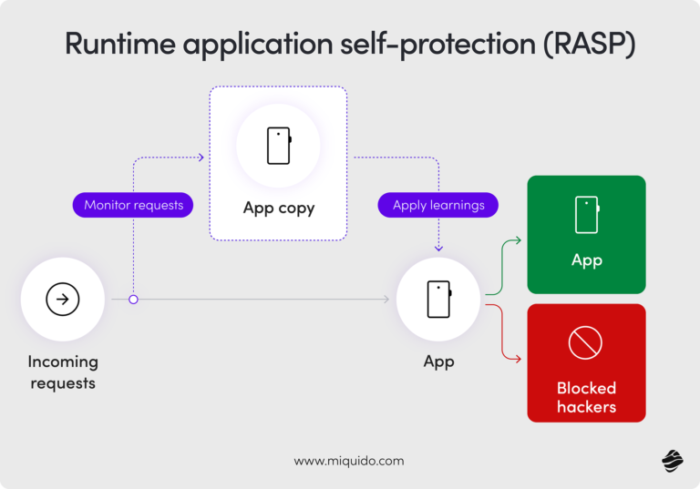
Mobile app security requires inspecting their runtime environment to defend against local exploits. Runtime Application Self-Protection (RASP) continuously monitors process execution to identify active debuggers, binary tampering, hooking frameworks (such as Frida or Xposed), and elevated host privileges (rooting or jailbreaking). If an integrity violation occurs, the RASP layer terminates critical sessions, revokes authentication tokens, and shuts down sensitive operations before background processes or keyloggers can capture private data.
Managing device permissions and local cache
These days mobile architecture adheres strictly to the Principle of Least Privilege. Instead of requesting sweeping system permissions during installation, applications utilize Just-In-Time (JIT) permissions and platform-native file pickers to access isolated resources only when required by a specific user flow. Furthermore, local data storage operates under a Zero-Trust model: cached data, authentication tokens, and user profiles must be encrypted via AES-256-GCM and bound directly to hardware-backed security modules, such as iOS Keychain or Android Keystore.
Compliance, governance, and the AI horizon
Application security extends beyond code-level fixes to encompass autonomous systems and strict regulatory compliance. Meeting these legal frameworks protects organizations against severe financial penalties, operational disruptions, and brand erosion.
Secure applications (both android and ios apps) must comply with industry-specific and regional data sovereignty standards:
NIS 2 Directive: Imposes stringent cyber hygiene and operational resilience requirements on critical infrastructure providers operating within the EU.
GDPR: Mandates strict consent, data minimization, and privacy-by-design for EU residents. Non-compliance fines can reach up to €20M or 4% of global annual revenue.
HIPAA: Governs US healthtech platforms, requiring end-to-end encryption, strict role-based access control (RBAC), and immutable audit logs for personal health information (PHI).
SOC 2 (Type II): Validates security, availability, and confidentiality controls for SaaS platforms targeting enterprise customers, particularly in fintech.
ISO/IEC 27001: Establishes a globally recognized Information Security Management System (ISMS) framework for risk management and continuous operational compliance.

Guarding the gateways of generative AI
Integrating Large Language Models (LLMs) creates novel attack vectors that target model behavior and context logic rather than classic software flaws:
- AI attack vectors: Systems face non-deterministic exploits including direct and indirect prompt injection, model inversion, and context window data exfiltration.
- Third-party AI supply chain: External LLM APIs and hosted models function as external dependencies, requiring strict vendor audits, data retention agreements, and SLA verifications.
- System prompt limitations: Relying solely on system prompts or instruction tuning fails to stop determined threat actors. Robust security requires external system boundaries.
AI guardrails and data privacy
Securing AI components requires programmatic controls that evaluate inputs and outputs outside the model's inference loop:
- Independent guardrail layers: Deploy dedicated validation services to intercept incoming prompts and sanitize outgoing completions before they reach the user or database.
- Payload sanitization: Scrub input streams for injection payloads and redact PII, API keys, or proprietary business logic from outgoing model responses.
- Real-time anomaly detection: Track token distributions, drift, and unexpected function calls in production to flag compromised sessions instantly.
- Automated defense integration: Utilize AI-driven Static Application Security Testing (SAST) and Dynamic Application Security Testing (DAST) tools. These solutions accelerate patch deployment and automated threat detection.
Conclusion: security as a scalable business advantage
Secure mobile applications need resilient systems that handle threats predictably. Treating security as a core architectural layer rather than a pre-launch patch protects your system from sensitive data breaches and lowers regulatory risks. Implementing Zero-Trust APIs, client-side hardening, and automated supply chain checks allows your software to scale safely without compromising delivery speed.
Secure your software architecture
Protecting complex web, mobile, and AI-driven platforms requires deep engineering expertise and proactive threat modeling. Whether you need an architecture audit, a compliance review, or specialized mobile hardening, our engineering team is ready to help.
Talk to our experts about your mobile application security.
Why is API security considered the bridge between web and mobile safety?
APIs connect modern mobile frontends to backend services. As a result, they serve as a primary attack vector across platforms. Securing APIs prevents vulnerabilities originating in a web environment (such as cross-site scripting or browser-based man-in-the-middle attacks) from compromising native mobile clients. Implementing measures like mobile certificate pinning, robust token validation, and strict request throttling creates a tamper-proof transport layer that protects backend systems regardless of the client entry point.
How often should our team conduct third-party library audits?
Dependency auditing should be automated directly within your CI/CD pipeline using tools like Snyk or GitHub Dependabot to scan every pull request for known vulnerabilities. Supplement this continuous integration scanning with scheduled reviews to selectively apply critical security patches without introducing unvetted third-party code into production builds.
Can code obfuscation completely stop a mobile app from being hacked?
Code obfuscation does not make an app unhackable, but it significantly raises the cost and complexity of reverse engineering. By scrambling class names, control flows, and string literals, obfuscation discourages opportunistic attackers. For comprehensive protection, it must be combined with runtime application self-protection (RASP) and integrity checks that prevent tampered or repackaged binaries from executing.
How does Generative AI change our application security strategy?
Integrating GenAI requires expanding traditional code-level security to cover data privacy, model integrity, and non-deterministic logic. Security teams must account for AI-specific threat vectors like prompt injection, data poisoning, and model inversion. This demands an independent guardrail architecture to validate inputs and outputs in real time, preventing unauthorized data exfiltration while monitoring for anomalous model behavior in production.

Top AI innovations delivered monthly!
The administrator of your personal data is Miquido sp. z o.o. sp.k., with its ... registered office in Kraków at Zabłocie 43A, 30 - 701. We process the provided information in order to send you a newsletter. The basis for processing of your data is your consent and Miquido’s legitimate interest.You may withdraw your consent at any time by contacting us at marketing@miquido.com. You have the right to object, the right to access your data, the right to request rectification, deletion or restriction of data processing. For detailed information on the processing of your personal data, please see Privacy Policy.

![[header] best way to outsource mobile app development without losing control](https://www.miquido.com/wp-content/uploads/2026/09/header-best-way-to-outsource-mobile-app-development-without-losing-control-2048x1365.jpg.webp)


![[header] enterprise mobile app development principles building for scale, security and long term value](https://www.miquido.com/wp-content/uploads/2026/09/header-enterprise-mobile-app-development-principles-building-for-scale-security-and-long-term-value-2048x1365.jpg.webp)
![[header] bridging the ai velocity gap how modern architecture drives operational scale (1) (1)](https://www.miquido.com/wp-content/uploads/2026/08/header-bridging-the-ai-velocity-gap_-how-modern-architecture-drives-operational-scale-1-1-2048x1365.jpg.webp)