
 6 Dec 2022
Is React Native Right for Your Business? The Ultimate Guide to Benefits, Limitations, and Alternatives
Selecting a mobile framework directly dictates your product’s performance, total cost of ownership, and market success. What exactly is React Native, and does it align with your operational roadmap? This guide breaks down the core business advantages, critical technical limitations, and cross-platform alternatives to help you make an informed architectural choice.
Key takeaways
- The cross-platform value: React Native lowers upfront development costs and accelerates time-to-market. The framework deploys a single, shared JavaScript/TypeScript codebase across both iOS and Android platforms.
- Simplified engineering scale: Relying on JavaScript simplifies talent acquisition and team scaling. The accessibility allows organizations to transition web developers into mobile roles without chasing rare native specialists.
- Not a universal solution: While versatile, React Native is not optimal for apps dependent on intricate 3D graphics, low-latency complex gestures, or intensive background data synchronization.
- Diverse framework alternatives: The mobile ecosystem offers tailored solutions. Google’s Flutter ensures pixel-perfect UI consistency, JetBrains' KMP shares business logic with native freedom, and pure Swift/Kotlin delivers peak hardware performance.
- Flexible integration path: React Native supports incremental adoption. Established enterprises can integrate it into specific legacy modules without undergoing a risky, full-scale application rewrite.
What is React Native and how does it work?
React Native (RN) is an open-source framework created by Meta in 2015. It allows developers to build high-performance mobile applications for both iOS and Android using a single JavaScript or TypeScript codebase. Unlike hybrid tools that merely display a website inside a mobile wrapper, React Native renders authentic, platform-specific UI components to ensure a genuinely native look, feel, and speed.
React Native vs. ReactJS
While both technologies share similar component-driven logic, they target entirely different environments:
- ReactJS (React.js): A front-end JavaScript library built exclusively for web browsers using HTML, CSS, and a web-based Virtual DOM.
- React Native: A comprehensive mobile development framework that replaces web standards with custom JavaScript stylesheets and compiles directly into native mobile elements.
Because both share the same React architecture, web developers can transition into mobile app engineering with a flat learning curve.
Native vs. cross-platform app development
- Native development (Swift/Kotlin): Building independent applications engineered exclusively for one platform. It delivers absolute peak performance, flawless 60fps animations, and immediate hardware access, but carries high capital costs and slow time-to-market due to managing two distinct teams.
- Cross-platform development (React Native): Creating multiple applications from a single, shared repository. It is highly cost-effective, offering compressed development lifecycles and streamlined maintenance, though it introduces a minor performance trade-off for apps with ultra-complex gestures or heavy background concurrency.
Why choose React Native? Core business benefits
React Native app development has become a preferred choice for businesses looking to establish a mobile presence efficiently by leveraging a single codebase to achieve significant strategic advantages.
Accelerated time-to-market
React Native reduces the time required to launch a product by enabling simultaneous development for iOS and Android. High code reusability, pre-made assets, and the Fast Refresh feature speed up the development lifecycle, allowing companies to capture market opportunities ahead of the competition.
Simplified talent acquisition and team scaling
Finding skilled developers is easier because the framework is based on JavaScript. The small technical gap between web React and React Native allows web developers to transition to mobile projects with minimal friction, bypassing niche native talent shortages.
Guaranteed brand consistency with less QA scope
Using a single codebase inherently ensures a more consistent user interface and logic across devices. Because UI definitions are shared, the scope for Quality Assurance (QA) is drastically reduced. A bug fixed in the shared repository is typically resolved for multiple platforms simultaneously.
Dramatic reduction in initial development costs
Native development requires two distinct, expensive teams for Swift and Kotlin. React Native offers a dual-platform value proposition, requiring only one engineering team to handle both platforms and reducing total man-hours.
Long-term maintenance and operational simplicity
Maintenance is streamlined because updates and feature parity are managed within a single repository rather than fragmented across separate teams. Furthermore, since RN operates directly on native OS elements, certain system updates handle themselves without requiring immediate App Store re-submission.
When not to use React Native?
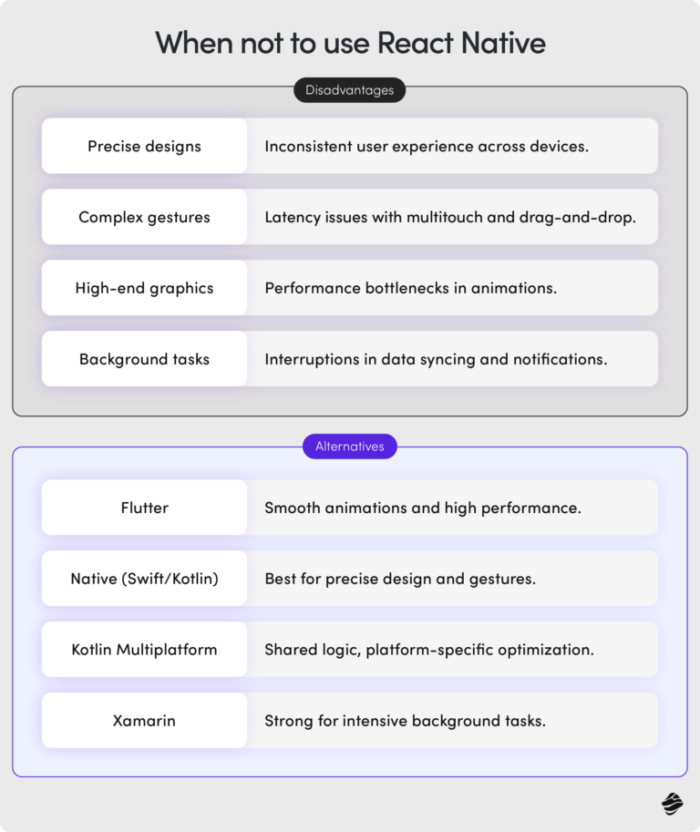
Strategic architectural constraints inherent in its design make it unsuitable for specific technical use cases:
- Pixel-perfect and highly fragmented UI requirements: React Native applications render using native platform components, meaning they must operate across a vast spectrum of devices, varying screen sizes, aspect ratios, and OS versions. The structural diversity makes it exceptionally challenging for engineering teams to guarantee a 100% consistent user experience across all form factors simultaneously.
- High-latency complex gestures: The framework’s abstraction layer over native gesture recognizers can introduce noticeable responsiveness issues. Complex UI interactions demand immediate, low-latency feedback loops that React Native’s traditional architecture can fail to process effectively.
- Intricate animations and multi-layered graphics: Because React Native historically relies on a bridge mechanism to communicate between the asynchronous JavaScript thread and the native main thread, performance bottlenecks frequently occur under heavy load. The communication bottlenecks limit the rendering flexibility and fluid performance required for highly interactive UI animations.
- Intensive background processing and concurrency: The primary JavaScript thread in React Native is highly susceptible to interruptions, which can abruptly disrupt continuous background tasks. The vulnerability makes the framework a sub-optimal choice for financial or enterprise applications that require heavy background data synchronization, complex offline ledger updates, or precise real-time notification processing cycles.
Top React Native alternatives
1. Flutter
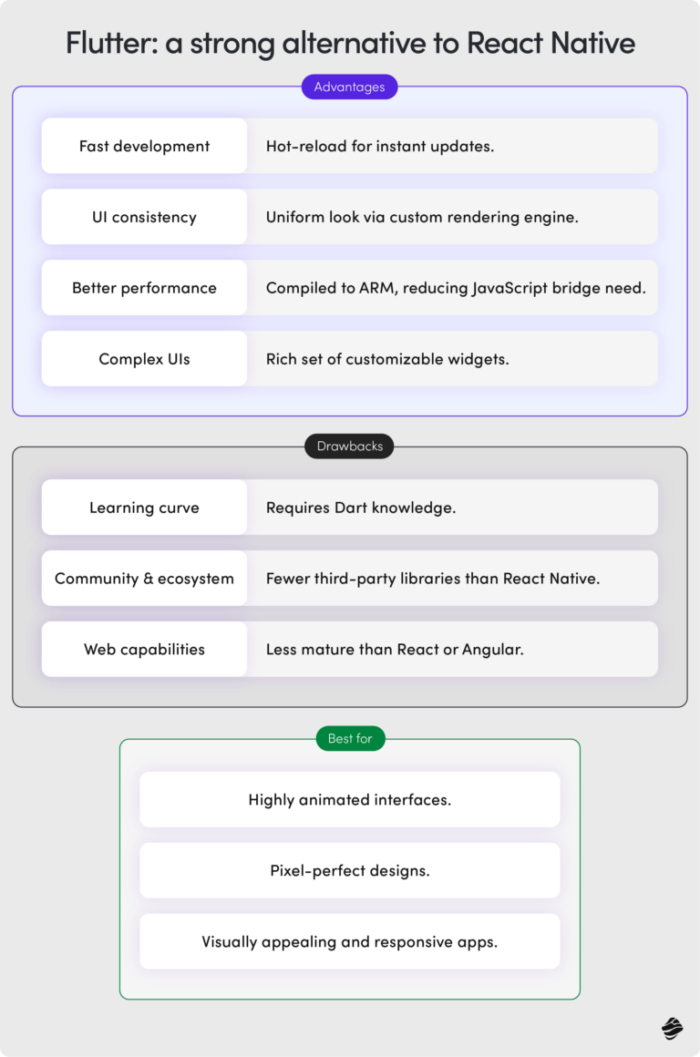
Launched by Google in 2017, Flutter is an open-source UI software development kit (SDK) that utilizes the Dart programming language to compile high-performance applications for mobile, web, and desktop from a single, unified codebase.
- Advantages: Unlike frameworks that wrap native elements, Flutter features its own dedicated custom rendering engine (Impeller/Skia) that controls every single pixel on the screen, ensuring absolute UI consistency across platforms. Performance is optimized via Ahead-of-Time (AOT) compilation directly to machine-level ARM code. This setup bypasses native bridges for fluid animations. Additionally, its stateful hot-reload ecosystem accelerates iteration speeds for engineering teams.
- Drawbacks: Development teams face a distinct learning curve if they are not already familiar with Dart. While its ecosystem is expanding rapidly, it still trails React Native slightly in terms of third-party library availability and native integrations.
2. Kotlin Multiplatform (KMP)
Developed by JetBrains, Kotlin Multiplatform (KMP) focuses on a modular architectural approach, allowing engineering teams to share core business logic across platforms while retaining the freedom to implement native UIs.
- Advantages: KMP reduces code duplication across platforms without forcing compromise on user experience. By compiling directly to native binaries, it supports uncompromised, zero-overhead access to platform-specific APIs and hardware features. The modular flexibility allows organizations to adopt KMP gradually within existing legacy systems rather than opting for a full-scale rewrite.
- Drawbacks: The iteration process can be slower for developers accustomed to hybrid setups, as KMP lacks a universal hot reload engine across all target environments. Additionally, navigating intermediate compilation layers between Kotlin, Swift, and Objective-C requires deep, specialized platform knowledge.
3. Ionic
Ionic is an enterprise-grade cross-platform framework that utilizes standard, widely adopted web technologies (HTML5, CSS, and JavaScript/TypeScript) alongside modern frameworks like Angular, React, or Vue to build mobile applications.
- Advantages: It is highly accessible for established web development teams, allowing them to transition into mobile app production with virtually no learning curve. It boasts a massive, comprehensive library of pre-designed, adaptive UI components and leverages Capacitor to bridge web-based code with native mobile device hardware features.
- Drawbacks: Because Ionic applications execute within a native WebView container, they can suffer from performance degradation and frame-rate drops in graphics-heavy or highly interactive applications. Achieving a truly authentic, platform-native look and feel often demands extensive, manual platform-specific CSS overrides.
4. PWA (Progressive Web Applications)
Progressive Web Applications (PWAs) are advanced web-based applications engineered to deliver native-like mobile experiences directly to users through standard desktop and mobile web browsers.
- Advantages: PWAs offer immediate, seamless background updates and can instantly reach users on any web-enabled device, completely bypassing App Store and Google Play deployment constraints, submission delays, and marketplace fees. They are highly optimized for fast initial load times and can function reliably even over unstable or offline networks.
- Drawbacks: Runtime execution remains bound to browser engine capabilities, leading to platform inconsistencies. Furthermore, PWAs have highly restricted or zero access to critical device hardware features, including Bluetooth, NFC, advanced biometric sensors, and low-level background execution controls.
5. NativeScript
NativeScript is an open-source framework designed to build truly native mobile applications using JavaScript, TypeScript, or Angular, providing direct, un-wrapped access to all iOS and Android native APIs.
- Advantages: It supports multiple modern web frameworks (including Vue.js and Svelte) and renders directly using native UI components, delivering performance that is very close to fully native solutions. It also includes robust support for Hot Module Replacement (HMR) to ensure fast coding cycles and real-time interface styling.
- Drawbacks: The global developer community and marketplace around NativeScript are significantly smaller than those of React Native or Flutter, which often results in fewer ready-made third-party integrations, less comprehensive documentation, and fewer open-source plugins.
6. Swift and Kotlin (Full Native)
The traditional software engineering approach involves the creation of two entirely separate, platform-specific codebases written in the primary native languages: Swift for iOS development and Kotlin for Android development.
- Advantages: The approach delivers the absolute maximum performance, lowest possible input latency, and unmatched responsiveness. Engineering teams gain immediate, 100% access to all newly released OS APIs, hardware accelerators, and system-level platform features without waiting for third-party cross-platform framework updates.
- Drawbacks: The method represents the most resource-intensive, expensive, and time-consuming route available. It requires organizations to maintain two separate repositories and hire distinct, highly specialized engineering teams, which significantly inflates long-term maintenance costs and total cost of ownership (TCO).
Comparative analysis of frameworks
- React Native: High development velocity, moderate operational cost, near-native runtime performance, and an exceptionally mature, enterprise-backed community ecosystem.
- Flutter: High development velocity, moderate operational cost, excellent near-native graphic performance, and a massive, fast-growing community.
- Kotlin Multiplatform (KMP): Moderate development velocity, moderate to high cost, full native execution performance, and a rapidly expanding enterprise adoption rate.
- Ionic: Ultra-high development velocity, low to moderate cost, fair web-based rendering performance, and a massive, deeply rooted web support community.
- PWAs: Ultra-high development velocity, exceptionally low development cost, fair baseline performance, and completely independent of centralized app store ecosystems.
- NativeScript: Moderate development velocity, moderate cost, good to excellent native performance, backed by a relatively small, highly specialized community.
- Swift & Kotlin: Lower development velocity, high capital cost, peak native hardware performance, and comprehensive, long-term support backed directly by Apple and Google.
Final verdict: how to choose the best framework?
Choosing the right mobile development framework is a strategic decision that directly impacts your app's performance, user experience, and long-term viability. React Native is an industry leader, but it is not a universal solution. The final choice must align with your specific product requirements, budget, and engineering capabilities.
Select:
- React Native if your primary goals are a short time-to-market and low development costs without sacrificing a native look and feel. It is perfectly suited for data-driven applications (like Shopify or Discord) and leverages a massive global pool of JavaScript talent.
- Flutter if your project demands pixel-perfect designs, intricate custom animations, and complete UI consistency across platforms via its dedicated rendering engine.
- Full Native (Swift and Kotlin) if you require absolute peak performance, fluid 60fps animations, or deep integration with platform-specific hardware.
- Kotlin Multiplatform (KMP) if you want to share core business logic across platforms while retaining the ultimate flexibility to write native UI code where necessary.
- Ionic or PWAs for simple applications or organizations with existing web codebases that need to reach a wide audience at the lowest possible cost.
Here’s a comparative analysis categorizing the cross-platform solutions we’ve discussed based on the above factors.
| Framework | Development speed | Cost | Performance | Community support |
| React Native | Fast | Moderate | Near-native | Strong |
| Flutter | Fast | Moderate | Near-native | Growing |
| KMP | Moderate | Moderate | Good | Growing |
| Ionic | Fast | Low to moderate | Fair | Strong |
| PWAs | Fast | Low | Fair to good | Moderate to strong |
| NativeScript | Moderate | Moderate | Good to excellent | Relatively small |
| Swift & Kotlin | Slow | High | Native | Strong |
Don’t let framework indecision delay your launch
Whether you are a fast-moving startup aiming for a rapid MVP or an enterprise scaling for global reach, choosing the right mobile architecture is your first step toward market success. Evaluate your budget, timeline, and performance needs to design a high-performance mobile strategy that puts your brand ahead of the competition.
Let’s talk about your mobile development strategy.
Can I convert my existing native iOS or Android app to React Native?
React Native is not an all-or-nothing solution. It can be integrated into existing native iOS or Android projects, allowing businesses to adopt the framework gradually rather than rebuilding from scratch. The setup makes it an integrated solution that can coexist perfectly with legacy native code.
When should a business avoid using React Native?
While versatile, React Native is not the optimal choice for certain types of projects. For instance, apps requiring intricate graphics and animations can hit performance bottlenecks due to the framework’s bridge mechanism. Similarly, complex gestures like multitouch or drag-and-drop may suffer from latency, and intensive background tasks like extensive data syncing can be interrupted on the JavaScript thread. Additionally, achieving pixel-perfect consistency across a massive variety of devices is technically challenging. Projects with extreme performance requirements generally still favor truly native development to eliminate any communication layer between languages.
How much money can my business actually save by choosing React Native?
Because project scope dictates the overall budget, final development costs vary based on your specific roadmap. Choosing React Native cuts baseline development expenditures significantly. Instead of funding separate Swift and Kotlin teams, a single cross-platform team builds for both iOS and Android simultaneously. The unified development approach reduces total man-hours and accelerates time-to-market. Furthermore, hiring becomes much more cost-effective due to the massive global pool of JavaScript developers. Long-term maintenance is also highly streamlined, as bug fixes are applied to a single shared repository, and native framework capabilities often eliminate the need for immediate App Store re-submissions after system updates.

Top AI innovations delivered monthly!
The administrator of your personal data is Miquido sp. z o.o. sp.k., with its ... registered office in Kraków at Zabłocie 43A, 30 - 701. We process the provided information in order to send you a newsletter. The basis for processing of your data is your consent and Miquido’s legitimate interest.You may withdraw your consent at any time by contacting us at marketing@miquido.com. You have the right to object, the right to access your data, the right to request rectification, deletion or restriction of data processing. For detailed information on the processing of your personal data, please see Privacy Policy.


