
 22 Jun 2025
 19 min read
![[header] predictive analytics in manufacturing cut downtime & costs](https://www.miquido.com/wp-content/uploads/2025/06/header-predictive-analytics-in-manufacturing_-cut-downtime-costs.jpg.webp)
As of 2025, over 77% of manufacturers have implemented AI solutions. The geopolitical landscape impacts supply chain management alongside the swinging economy and shifts in manufacturing powers. Under these conditions, AI is turning into a necessity.
Cloud computing and Industry 4.0 concepts allow manufacturing data to flow efficiently in modern factories. Integration and smart devices process this data in massive quantities. Artificial intelligence utilizes this information to improve operational efficiency.

Various applications demonstrate the potential of AI in manufacturing. These use cases help factories better predict, plan, and react to unplanned downtime. Such disruptions are increasingly common in today's unstable economy.
The intelligent factory: How AI agents, computer vision, and GenAi are redefining manufacturing
The twenty-first-century factory is highly automated. Advanced robotics allow production lines to function partially autonomously. Dark factories in China even operate entirely without human intervention.
Artificial intelligence supports these changes from the background. The technology acts as the brain of operations to detect hidden patterns and threats. Process automation allows for rapid reactions when suppliers fail or machinery malfunctions.
Agentic AI, Generative AI, and computer vision create an intelligent ecosystem for safer and faster production. These tools identify patterns and forecast future outcomes by collecting equipment data. Systems improve inventory management and defect detection with minimal human intervention.
Strategic benefits of integration: How AI changes the manufacturing industry
Modern companies utilize advanced analytics to transform production data into actionable insights. Machine learning algorithms allow these organizations to optimize every stage of the lifecycle.
Manufacturing predictive analytics and predictive maintenance
AI-powered predictive maintenance solutions allow manufacturers to anticipate equipment failures and avoid costly disruptions. The savings from such AI application can be significant, as the example of BMW shows. In January 2024, BMW implemented an AI-supported predictive maintenance system to monitor conveyor technology during vehicle assembly. This integrated, learning maintenance system identifies potential faults early, preventing over 500 minutes of assembly disruption annually.
Enhanced quality control
AI revolutionizes quality control by ensuring consistent standards and detecting defects in real time. AI-powered cameras inspect products for imperfections, reducing waste and ensuring only flawless items reach customers. Automated systems continuously refine manufacturing processes, reducing errors and enhancing product consistency.
Improved product quality
Generative AI design can put a manufacturer a few steps ahead of competition, facilitating personalization and efficient resources usage. AI optimizes product designs by finding ways to use materials efficiently, reducing costs while maintaining quality.
The manufacturer can, for instance, integrate generative AI with different social media and eCommerce channels to detect product defects in reviews and automatically suggest alternative designs that align with company goals. Generative design can radically shorten the design cycle, event with the most specialized equipment, as Protolabs' space travel apparatus for NASA, delivered in just 36 hours using digital manufacturing techniques.
Supply chain & inventory optimization
Demand forecasting and AI in production planning is one way companies can achieve supply chain optimization, adjusting production levels and order volumes to match current and future conditions. AI systems process data from across the supply chain, continuously refining demand forecasts, adjusting planned orders and the number of products leaving the assembly line each day.
Additionally, AI supports logistics optimization by analyzing traffic, weather, delivery and production schedules to select the best shipping routes. The system then assigns these optimized routes to drivers, cutting transportation costs and minimizing delays.
Enhanced workplace safety
Despite the increasing awareness of manufacturing-related health risks, assembly line workers still face various threats. AI enables effective hazard identification, continuously monitoring key elements of the assembly line and factory for potential risks, such as machinery performance and malfunctions, air quality and toxic gas leaks, temperature fluctuations and fire hazards, as well as electrical systems and overload danger.
Increased operational efficiency & productivity
A typical large factory consumes 1 to 5 megawatts (MW) of energy per day, powering a wide range of essential manufacturing operations. AI can collect and analyze real-time data regarding energy usage throughout the entire facility, identifying inefficiencies and recommending adjustments that ensure maximum efficiency while reducing operational costs.
In addition to cost savings, manufacturers are using AI models to reduce their environmental impact. By performing complex calculations, AI can estimate the carbon footprint of specific manufacturing processes and offer the simplest, most effective strategies to reduce emissions in high-impact areas.
Aside from reducing emissions, AI-driven systems can also help manufacturing companies minimize waste. AI can detect defects earlier in the production process and applying predictive maintenance to fix or replace the faulty component before it causes further disruptions.
Predictive analytics: Moving from reaction to preparation
Predictive analytics doesn't solve the problem of market volatility at its source, but it enables manufacturers to prepare and respond proactively – avoiding downtime and cost increases before they materialize. Research by Deloitte shows manufacturers report a 30–50% reduction in machine downtime. These predictive approaches decrease maintenance costs by up to 40%.

Evidence from research shows that predictive analytics in manufacturing brings tangible results. Maximizing the potential of predictive analytics requires seamless collection and integration of data from various sources. Manufacturing organizations rely on multiple data streams:
- IoT sensors for equipment monitoring
- MES for production tracking
- ERP systems for business operations
- SCADA systems for process control
- QMS for product standards
- CMMS for asset upkeep
- WMS for inventory control
- Line sensors for operational data
However, internal data alone rarely suffices. Successful implementations incorporate partner data and customer demand patterns. These systems also analyze supplier performance metrics and public economic information.

Generative ai: The new frontier of design and workflow
Using generative AI, manufacturers can streamline repetitive and error-prone tasks, unlocking human resources and enabling general managers and similar professionals to focus on their critical responsibilities.

Automated order processing
Every manufacturer knows how a single mistake in an order can spiral into wasted materials, costly delays, and unhappy customers. AI and machine learning now make it possible to digitize and automate the entire order management workflow. OCR systems recognize documents in any format such as scans, photos, or PDFs, while intelligent configurators analyze technological rules, check component availability, and validate data before it hits your ERP system.

Polish joinery company Ekookna took an advantage of GenAI's potential for automated order processing.
"With individual orders, the pressure for precision is immense. A single mistake in the specification, even in a PDF file, can mean the entire batch needs reworking. That's a loss of time, money and customer trust"
Tomasz Bawełkiewicz, Business Architect at Miquido
Intelligent billing and payment matching
Automation in payments is another area where efficiency pays off. AI systems analyze inconsistent transfer data to match payments with correct orders. The software integrates with ERP and CRM systems to keep records synchronized. Finance teams no longer waste time hunting for missing references. Invoices are closed faster due to this automation.
"AI systems in finance go far beyond automated bookkeeping. They enable intelligent information processing. The system can independently identify which order a payment belongs to, even if the reference number is missing or there are inconsistencies in the payment decription."
Jerzy Biernacki, AI Consultant at Miquido
Enhancing training data for AI-driven quality control
Generative AI in manufacturing makes it possible to bridge data gaps with synthetic data, cutting training time and expenses. Merck is a compelling example. By integrating AWS services with cutting-edge AI in manufacturing, they use GANs and Variational Autoencoders to simulate complex defects. This has transformed their quality control processes, reducing deviations, improving safety, and saving millions annually.
AI agents in manufacturing industry
Unlike generative AI, agentic AI in manufacturing is proactive rather than reactive. Such agents adjust actions in real time based on changing factory conditions and make autonomous decisions.
- In manufacturing sales and customer service, AI agents act like tireless account managers. They answer customer queries in multiple languages, track inventory in real time, and generate precise delivery dates—often before a human could even draft a response.
- In quality control, they are the ultimate watchdogs. They scan streams of machine data 24/7, fine-tune inspection tools on the fly, support predictive maintenance, and trigger corrective actions the moment production drifts off-spec.
- For workforce management, they become dynamic planners. They forecast staffing needs, build shift schedules that balance workloads, and instantly deliver training modules to employees when new procedures roll out.
- And in compliance, AI agents quietly act as your internal auditors. They keep up with the latest regulatory changes and compile ESG reports automatically, ready for inspection at any time

Computer vision in manufacturing: Transforming quality and precision
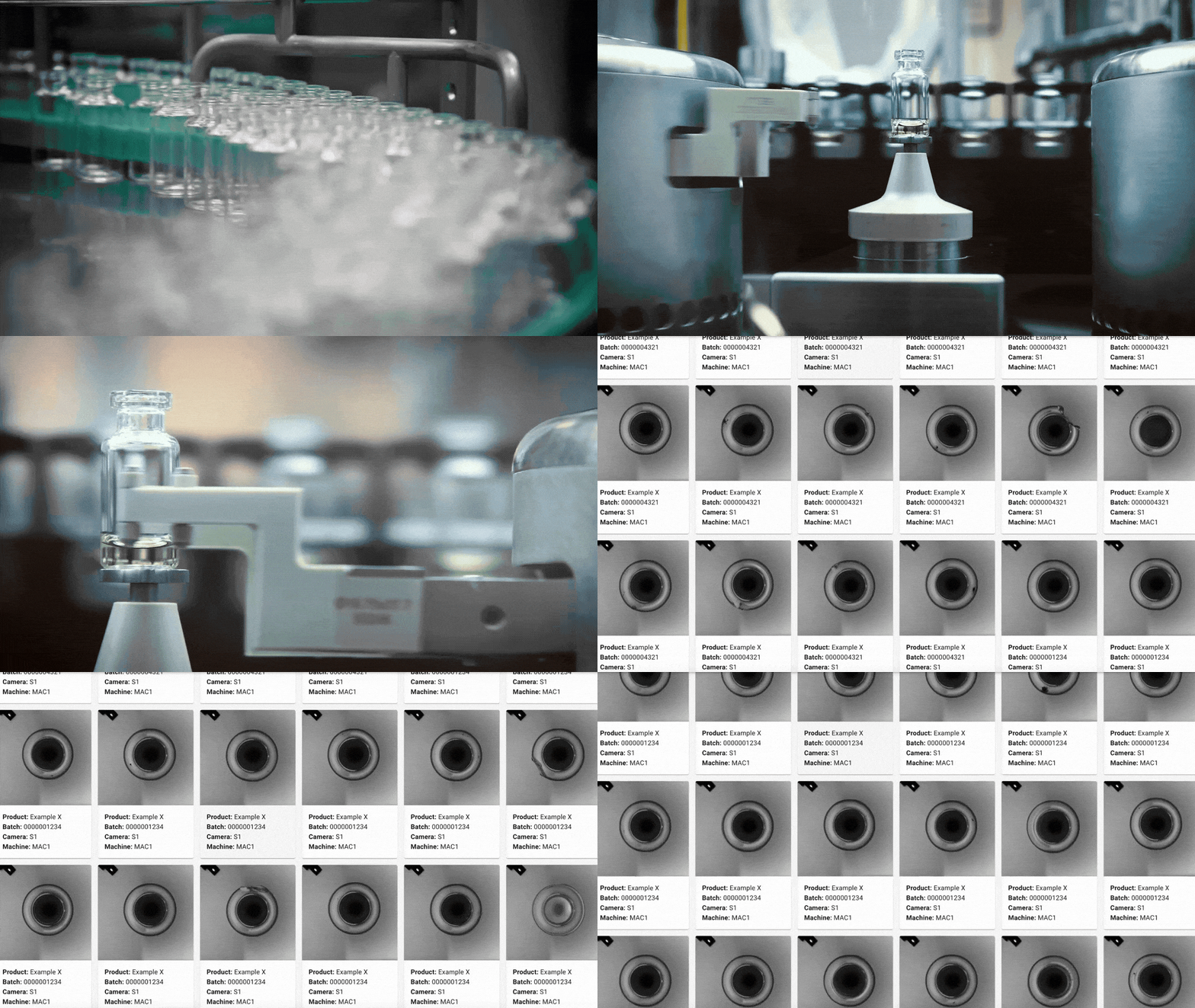
Precision vision transforms manufacturing by automating the exhausting task of manufacturing quality control, handling volumes that would overwhelm the human eye. A pharmaceutical line may process 10,000 tablets every hour. Human inspectors succumb to fatigue, but vision systems remain tireless and precise. By utilizing advanced image recognition, these systems can boost overall productivity by 50%.
Across the assembly line, these applications provide a universal layer of protection by verifying product integrity at every stage of production. Vision systems verify product integrity from raw material inspection to final packaging. Components must meet exact specifications for size, shape, and placement. It automatically flags foreign objects, detects surface anomalies, and verifies that labels are legible and seals are intact.

Despite this immense potential, manufacturers face significant technical hurdles, such as managing high-speed throughput and adapting sensors to varying environmental conditions like dust, humidity, or shifting light. In industries like foodtech, products with high natural variability in texture and color require sophisticated algorithms that go beyond simple pattern matching. Bridging the gap between a successful pilot and a full-scale deployment demands deep manufacturing expertise to navigate these environmental complexities and ensure the technology delivers a reliable return on investment.
Regulatory compliance in manufacturing: Mastering risk and standards
Automated platforms utilize natural language processing to parse shifting international laws in real-time, instantly flagging relevant updates across disparate jurisdictions. Systems automate the generation and classification of legal documentation. This ensures that submissions to the FDA or EMA adhere to precise requirements. AI agents reconcile conflicting standards by cross-mapping legal definitions. This process eliminates the manual ambiguity that leads to expensive penalties.
Safety compliance
Computer vision systems transform workplace safety by continuously monitoring video feeds to detect missing protective gear or incorrect equipment usage, providing supervisors with instantaneous risk alerts. Digital safety assistants and AI chatbots further bolster compliance by conducting pre-shift check-ins and delivering contextual protocol reminders directly to workers on the floor. Additionally, manufacturing predictive analytics process IoT sensor data and historical incident logs to forecast equipment failures, preventing accidents before they occur and reducing the need for costly manual inspections.

Quality compliance
Advanced anomaly detection models monitor real-time production variables such as temperature, pressure, and viscosity to catch subtle deviations that would otherwise trigger expensive product recalls. These machine learning tools unify fragmented data from ERP and paper records into a centralized platform, ensuring a state of constant audit-readiness for international standards like ISO 9001. To streamline administrative burdens, natural language generation tools automatically draft corrective and preventive action (CAPA) reports, reducing manual workloads by up to 75% while maintaining strict accuracy.

Environmental compliance
Integrated IoT systems powered by AI provide continuous monitoring of emissions and issue alerts as levels approach dynamic regulatory thresholds. These platforms automate the labor-intensive process of ESG reporting by analyzing energy consumption, transport data, and supplier metrics to generate Scope 1, 2, and 3 disclosures. By converting complex environmental mandates into specific parameter settings for factory machinery, AI ensures that sustainability goals are met without the typical months of manual recalibration.
| Compliance area | European Union (EU) | North America (US/CA/MX) | Asia-Pacific (APAC) |
| Legal & tech | Adherence to EU AI Act (traceability & human oversight). | Compliance with FDA submissions and USMCA trade rules. | Alignment with NMPA (China) or PMDA (Japan) filings. |
| Safety | Compliance with Directive 89/391/EEC and ISO 45001. | Enforcement of OSHA workplace safety and reporting standards. | Adherence to WSH Act (Singapore) or Work Safety Law (China). |
| Quality | Strict MDR for medical devices and ISO 9001 certification. | Alignment with CGMP (Current Good Manufacturing Practice). | Verification of regional quality benchmarks and export audits. |
| Environment | REACH chemical compliance and Emissions Trading Scheme. | EPA Clean Air/Water Acts and Prop 65 (California) labeling. | National laws like NEA (Singapore) or ASEAN haze protocols. |

Future outlook: Embracing the intelligent era
Manufacturing leaders must recognize that technological integration is no longer optional for maintaining market relevance. The transition toward fully autonomous systems requires a strategic roadmap that prioritizes data-driven decision making and workforce upskilling. By consistently collecting data across every stage of production, manufacturing companies can transform raw information into actionable intelligence.
The integration of manufacturing analytics is essential for building resilience against modern economic shifts. Organizations that successfully implement these tools will likely secure a permanent competitive advantage by:
- Anticipating and responding to sudden supply chain disruptions before they impact the bottom line.
- Refining internal processes through real-time monitoring and predictive modeling.
- Moving beyond pilot projects to achieve factory-wide digital excellence.
Early adoption allows organizations to stabilize their operations before market volatility increases further. The coming decade will define which players lead the next industrial revolution through a commitment to digital excellence and precision-led strategy.

Top AI innovations delivered monthly!
The administrator of your personal data is Miquido sp. z o.o. sp.k., with its ... registered office in Kraków at Zabłocie 43A, 30 - 701. We process the provided information in order to send you a newsletter. The basis for processing of your data is your consent and Miquido’s legitimate interest.You may withdraw your consent at any time by contacting us at marketing@miquido.com. You have the right to object, the right to access your data, the right to request rectification, deletion or restriction of data processing. For detailed information on the processing of your personal data, please see Privacy Policy.

![[header] b2b ecommerce for manufacturing – 21 feature ideas for cutting costs and multiplying sales](https://www.miquido.com/wp-content/uploads/2025/09/header-b2b-ecommerce-for-manufacturing-–-21-feature-ideas-for-cutting-costs-and-multiplying-sales.jpg)

![[header] top 10 foodtech startups to watch in 2025](https://www.miquido.com/wp-content/uploads/2025/07/header-top-10-foodtech-startups-to-watch-in-2025.jpg.webp)