

 17 Jul 2026
 18 min read
![[header] super app design principles & best practices](https://www.miquido.com/wp-content/uploads/2026/01/header-super-app-design-principles-best-practices-2048x1365.jpg.webp)
Why Your Business Needs a Super App
How do you turn a single digital product into an indispensable, multi-service ecosystem? Striking the perfect balance between extreme functional complexity and effortless user experience is the ultimate challenge for modern product leaders. Discover the latest market trends and shifts in data sovereignty. Learn the essential UI/UX design principles needed to scale a compliant, friction-free super app that earns user trust and dominates the digital landscape.
Key takeaways
- Unified Infrastructure: Secure Single Sign-On (SSO) and embedded payments are the essential backbone of any super app. This shared foundation drives daily habits by eliminating checkout friction.
- The European Path: Success in Europe requires a decentralized, privacy-first approach that respects data sovereignty. Copying centralized models is impossible due to GDPR and market fragmentation.
- VAS-Led Evolution: Platforms must scale incrementally by layering logical, value-added services onto a strong core product. This evolutionary approach builds user trust and de-risks expansion.
- Modular Scalability: Using microservices and API-first designs prevents app bloat. Integrating lightweight mini-programs allows rapid third-party scaling without hurting performance.
- Invisible UX Complexity: A unified design system and progressive discovery keep the user experience simple. Context-aware layouts reduce cognitive load by showing features only when they are needed.
What is a Super App?
A super app is a digital ecosystem combining multiple services, such as payments and transport, into a single interface. It relies on three main pillars: secure Single Sign-On (SSO), embedded payments, and third-party mini-programs that expand functionality without bloating the app. The global super app market is projected to reach $440 billion by 2030.

The State of Super Apps in Europe: Why is it Different?
Europe will not replicate the centralized Asian model seen in apps like WeChat. Growth faces three key barriers: strict GDPR regulations, high market fragmentation, and consumer skepticism toward sharing sensitive data with a single private entity.
Instead, the European market is moving from specialized single-purpose apps to strategic rebundling. The transition begins with securing user trust through a high-frequency core service. After establishing this anchor, companies gradually layer value-added services (VAS) to build a self-sustaining ecosystem. The ecosystem structure drives monthly active users (MAU) and maximizes customer lifetime value (LTV).
In Europe there is one place where super apps actually work, and it is the banking app. Europe chased the format after watching it grow in Asia, then found a continent already full of small separate services that had never let anyone down — nobody here needed rescuing from them. Value-added services sell inside a banking app because the bank's name carries credibility, and credibility is the one thing a new super app cannot ship in a release.
Piotr Polus Head of Technology
Top Examples of Super Apps in Europe
The European super app market relies on rebundling. Platforms start with a high-frequency core service and add value-added services (VAS) to drive customer lifetime value. The market leaders driving this evolution in Europe include the following companies.
- Revolut (fintech & lifestyle)
Revolut started as a digital currency exchange that offered peer-to-peer payments. The platform expanded its financial core into a lifestyle ecosystem.
It now integrates stock and cryptocurrency trading, travel insurance, and lifestyle rewards. The app also features a dedicated in-app hotel booking engine named Revolut Stays. Over 50 million users now employ the application as an everyday financial control center.
- Klarna (retail commerce & fintech)
Klarna entered the market as a "Buy Now, Pay Later" (BNPL) payment gateway. It later rebundled the retail journey into a single shopping ecosystem. The platform integrates AI-driven personalized shopping assistants alongside smart price-comparison tools. The company also expanded into telecommunications through Klarna Mobile to blend utility with consumer commerce.
- Bolt (mobility & on-demand services)
Bolt began as a ride-hailing and taxi dispatch service. Operating on a "Go & Get" model, Bolt leverages high-frequency user interactions to dominate urban logistics. The app unifies ride-hailing, micromobility options like e-scooters and e-bikes, car-sharing via Bolt Drive, and on-demand food delivery through Bolt Food.
Benefits and challenges of super apps
Deploying a super app involves balancing high-yield business growth with strict technical and regulatory constraints. Integrating multiple service verticals into a single platform unlocks unparalleled customer retention. However, scaling such an ecosystem within the heavily regulated European market requires navigating complex compliance frameworks and cultural fragmentation.
| Benefits of super apps | Challenges of super apps |
|---|---|
| All-in-one user convenience | Data privacy and regulatory compliance (e.g., GDPR) |
| Cross-service personalization | High technical complexity and architecture demands |
| Higher customer retention and loyalty | Difficulties in unifying UX across services |
| Platform-based monetization (ads, fees, data) | Security risks from integrating multiple services |
| Improved data insights for service optimization | Dependency on reliable third-party partnerships |
| Increased user engagement and frequency | Market fragmentation across regions and languages |
| Easier scalability through third-party integrations | User skepticism over data sharing with private entities |
The Business Value: Why Build a Super App?
Massive customer retention
The ultimate goal of a super app is to become an indispensable, everyday digital environment for the user. The indispensable status drastically increases brand loyalty and minimizes churn.
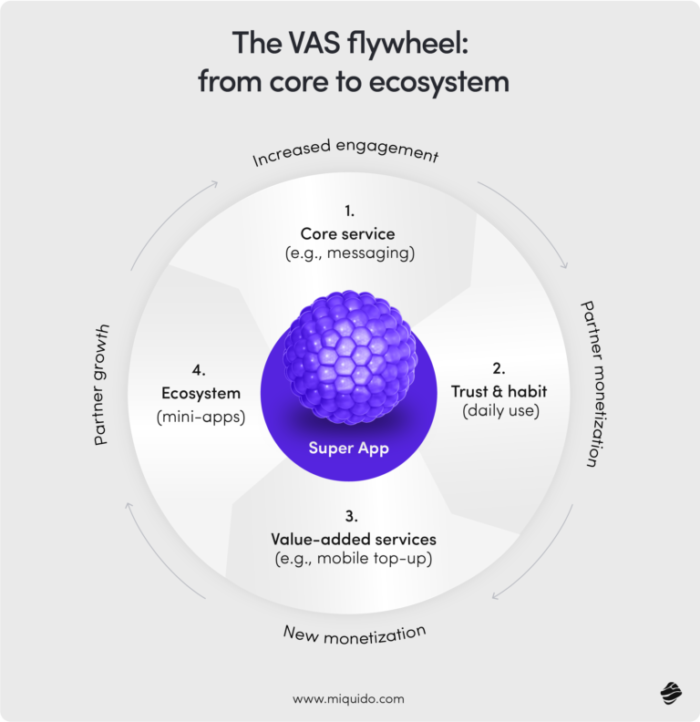
- The ecosystem flywheel: By integrating high-frequency daily services like messaging or mobility, the platform roots itself into subconscious user habits. The integration boosts Monthly Active Users (MAU) and transforms the application into a default operating layer for daily life.
- AI-driven loyalty loops: Modern personalization engines utilize advanced deep learning models to tailor user experiences in real time. Dynamic personalization creates highly customized environments and makes the switching cost prohibitively high for consumers.
Lower customer acquisition cost
From a financial perspective, the super app model allows enterprises to scale efficiently. Businesses can launch entirely new services at a fraction of the cost required to build separate applications.
- Frictionless cross-promotion & VAS: Launching new features or Value-Added Services (VAS) within an established ecosystem eliminates the need for expensive customer acquisition campaigns. By leveraging the existing user base, brands can organically cross-promote new services to de-risk expansion and validate market demand step-by-step.
- Scalable partner ecosystems: Opening the platform to third-party mini-programs fuels rapid feature diversification. The approach scales your digital marketplace without draining internal engineering resources.
Data synergy
Consolidating multiple service verticals within a single, unified framework generates a profound informational advantage that single-purpose apps simply cannot replicate.
- Holistic behavioral insights: Capturing financial transactions and retail shopping inside one interface generates multi-dimensional data. The consolidated framework offers a deeper understanding of real-time user intent.
- Predictive revenue optimization: Advanced predictive models cross-reference consumer patterns to anticipate needs before they arise. The resulting insight enables high-margin features like trigger-based upselling, smart inventory management, and proactive fraud detection.
Key Principles of Super App UI/UX Design
1. Modular architecture & mini-programs
Super app's success relies on a modular, microservices-based architecture. This structure prevents catastrophic app bloat while offering dozens of diverse services. Under this model, each service operates as an independent segment. This isolation allows product teams to scale, optimize, or update specific features without risking the stability of the entire platform.
An API-first gateway manages all backend traffic, user authentication, and routing. This configuration enables the seamless integration of mini-programs, which are lightweight internal applications that run directly inside the parent app. Mini-programs allow third-party partners to deploy new services instantly without forcing users to install external software. The setup effectively transforms a static application into a living, dynamic digital marketplace.
The ultimate UX hurdle for such apps is making massive functional complexity completely invisible to the end user. This simplicity is achieved through progressive discovery. The interface keeps core daily actions immediately accessible while introducing niche services contextually as the user navigates.
- Context-aware personalization: Modern super app interfaces dynamically adapt to real-time user behavior, location, and time of day. The home screen automatically prioritizes ride-hailing during morning commuting hours, shifting focus to food delivery or entertainment in the evening to match user intent.
To tie this vast ecosystem together, global search bars and contextual shortcuts are embedded across the platform. These elements allow users to locate specific functions in seconds.
3. A unified design system
Consistency is the single defining factor that separates a premium, polished super app from a fragmented, confusing portal. A unified design system ensures that every service, whether built by your internal engineering team or an external third-party developer, looks and feels like part of a singular product. This cohesion is achieved through shared design tokens, standardized component libraries, and predictable interaction patterns.
Enforcing strict visual and navigational rules drastically reduces the user's cognitive load. As a result, users can navigate new services intuitively without a steep learning curve. Furthermore, a centralized design system makes it significantly easier to enforce digital accessibility standards, such as WCAG compliance, so that the ecosystem is inclusive and fully usable for everyone.
4. Frictionless unified payments & identity
At the absolute center of the super app ecosystem is a shared infrastructure designed for seamless identity verification and financial transactions. A unified Single Sign-On (SSO) system provides a one-click login across all services, completely eliminating the friction of repetitive authentications.
By embedding finance directly into the platform through a central digital wallet, mobile users can pay for any transaction (from a quick taxi ride to a monthly utility bill) without ever re-entering their credit card or banking details.
The European privacy standard: Security features like encryption and multi-factor authentication (MFA) are global baselines. However, the European market requires a shift toward decentralized identity models. In the EU, successful super apps will integrate with secure, sovereign digital credentials, such as mobile driving licenses. This setup allows users to verify their identity while retaining full ownership of their raw personal data.
VAS as the starting point of the service ecosystem
Most super apps do not emerge fully formed. Instead, they follow a strategic evolution from a focused core product that gradually expands through Value-Added Services (VAS). This model is the most sustainable path to market dominance because it deepens platform value without fracturing the user experience.
The incremental evolution
Instead of overwhelming users with unrelated features, successful platforms scale by building logical adjacencies around established daily habits:
- Natural extensions: Payment apps expand into utility bill management, mobility platforms branch into food delivery, and messaging tools seamlessly integrate e-commerce.
- Core reinforcement: Every secondary service drives users back to the primary application, increasing daily engagement frequency and brand dependency.
The ecosystem flywheel
As value-added services accumulate, they transition from isolated features into a self-sustaining ecosystem. Tied together by a shared payment, identity, and data infrastructure, they create a compounding loop. Enhanced customer engagement generates richer behavioral insights, making the platform increasingly personalized and valuable.
Strategic and design advantages
A VAS-first methodology offers critical commercial and technical advantages throughout the development lifecycle:
- Controlled complexity: UX teams can introduce features gradually through progressive discovery, while engineers evolve the backend into a modular, API-first architecture.
- De-risked scaling: By proving value incrementally, platforms effectively earn the right to expand, validating market demand before executing a full-scale rollout.
Conclusion: The future of super apps in Europe
Europe is carving out its own distinct blueprint for the super app era, projected to reach a massive $440 billion global market value by 2030. Rather than replicating the centralized, data-monopolizing ecosystems seen in Asia, successful European platforms will win on data sovereignty, privacy, and user trust.
The path forward lies in decentralized identity models. Forward-thinking brands can build highly integrated ecosystems that respect strict local regulations. They achieve this by allowing users to securely authenticate services, such as digital driver's licenses, without handing over raw personal data to a single private entity. In Europe, the ultimate super app won't be the one that aggregates the most data, but the one that seamlessly connects daily services while leaving the user in absolute control of their digital footprint.

Ready to build a trust-first super app?
The race to capture the European super app market is on. To win, your platform must balance high-performance features with data privacy and modular scalability. By adopting an API-first architecture, integrating decentralized identity, and designing frictionless payment gateways, you can turn your existing application into an indispensable daily ecosystem.
Partner with Miquido to architect a compliant, highly secure, and beautifully designed super app that meets user preferences and drives long-term market growth.
Let's discuss your development process strategy.

Why are mini-apps and mini-programs critical to super app growth?
Mini-apps enable super apps to expand their service ecosystem without increasing app bloat or overwhelming users. They allow third-party partners to launch lightweight services inside the super app, reducing time-to-market, preserving UX consistency, and turning the platform into a dynamic marketplace rather than a closed product.
What makes a super app different from a regular multi-feature app?
A super app is not just an app with many features. It is a unified digital ecosystem built around shared identity, payments, data, and trust infrastructure. Unlike traditional multi-feature apps, super apps allow multiple services to coexist seamlessly within a single platform, which creates compounding value through integration rather than standalone functionality.
Why are there fewer super apps in Europe compared to Asia?
Europe's unique digital landscape is shaped by strict GDPR compliance and highly fragmented regional markets. European consumers are naturally skeptical about centralized private tech monopolies storing sensitive data. Consequently, the market favors a decentralized, privacy-first approach and sector-specific rebundling rather than a single, WeChat-style monolithic platform.
Can I turn my existing app into a super app?
Any dominant super app is rarely launched fully formed. They usually evolve from a single, highly successful core product through a Value-Added Service (VAS) strategy. You can transition an existing app by securing a strong user base with your primary service and gradually layering on logical adjacencies, such as expanding from mobility into food delivery.
The evolutionary approach builds user trust incrementally. However, it requires transitioning your backend to a modular, API-first architecture that can support third-party integrations and mini-apps without making the core platform bloated or slow.
What is the most important feature of a super app?
The absolute backbone of any super app development is a unified identity and payment system. This integration allows users to access a wide variety of services under a single, secure login while utilizing a central digital wallet to complete transactions instantly without re-entering financial details. By combining secure identity verification with embedded finance, you eliminate the friction of switching between services, creating a self-reinforcing ecosystem where users naturally default to your platform for their daily needs.

Top AI innovations delivered monthly!
The administrator of your personal data is Miquido sp. z o.o. sp.k., with its ... registered office in Kraków at Zabłocie 43A, 30 - 701. We process the provided information in order to send you a newsletter. The basis for processing of your data is your consent and Miquido’s legitimate interest.You may withdraw your consent at any time by contacting us at marketing@miquido.com. You have the right to object, the right to access your data, the right to request rectification, deletion or restriction of data processing. For detailed information on the processing of your personal data, please see Privacy Policy.

![[header] value added services in banking (1)](https://www.miquido.com/wp-content/uploads/2025/06/header-value-added-services-in-banking-1.jpg.webp)

![[header] fintech super apps lessons from miquido’s development playbook](https://www.miquido.com/wp-content/uploads/2025/08/header-fintech-super-apps_-lessons-from-miquidos-development-playbook.jpg.webp)
![[header] the rise of super apps in europe – opportunities, challenges,and future directions](https://www.miquido.com/wp-content/uploads/2025/05/header-the-rise-of-super-apps-in-europe-–-opportunities-challengesand-future-directions.jpg.webp)