
 27 Mar 2026
![[header] mobile app development statistics 2026 – trends, technologies, regional leaders](https://www.miquido.com/wp-content/uploads/2026/03/header-mobile-app-development-statistics-2026-–-trends-technologies-regional-leaders-2048x1365.jpg.webp)
As we move through 2026, mobile apps have become the primary, and often exclusive, gateway for businesses to reach the next generation of global consumers.
Companies increasingly understand that the future is mobile, and there is no escaping this channel if they want to secure their market position in the years ahead. Market leaders are already making mobile their key business channel, leveraging the opportunities offered by access to this universal touchpoint.
What trends currently dominate mobile development? Which technologies are most commonly chosen? Where can we find leaders in mobile app development, and which companies are handling this task best? What is the situation in app stores, and how does it influence software development trends? Let’s take a look at the data to answer these and other questions.
Why mobile development’s significance is surging in 2026
The digital landscape is being redefined by a "mobile-only" reality where smartphones serve as the central hub for all human activity.
- Generation Z has officially become the most digitally saturated demographic in history, utilizing mobile devices as their primary gateway to the internet. According to eMarketer, US Gen Z internet penetration reached 99.1% in 2024—surpassing Millennials at 97.4%—establishing Gen Z as the most digitally saturated generation in history (eMarketer, 2024).
- The influence of mobile-first interfaces begins in childhood, as the newest generation of consumers is already being conditioned by AI and social media. PwC's 2026 Gen Alpha Survey Report reveals that Gen Alpha (born 2010–2024) are already influencing household spending, using social media and AI natively (PwC, 2026).
- Social engagement is now structurally inseparable from smartphone user base and ecosystems, with the most popular platforms being built exclusively for mobile use. Statista data identifies the most-used social media platforms among Gen Z globally as mobile-native, underscoring that engagement is anchored to smartphones (Statista, 2023).
- Young adults are spending the vast majority of their online time on handheld devices, with smartphones accounting for over 80% of their daily usage. Adults aged 18-24 spend 6 hours and 20 minutes daily online, with 81% of that time spent specifically on smartphones (Ofcom, 2025).
- Mobile has become the "home base" for users, capturing the lion's share of activity even in complex, cross-platform journeys. Mobile holds 60-80% of user activity, with gaming showing a mobile-PC loop capturing 79% of final-stage activity (AppsFlyer, 2024).
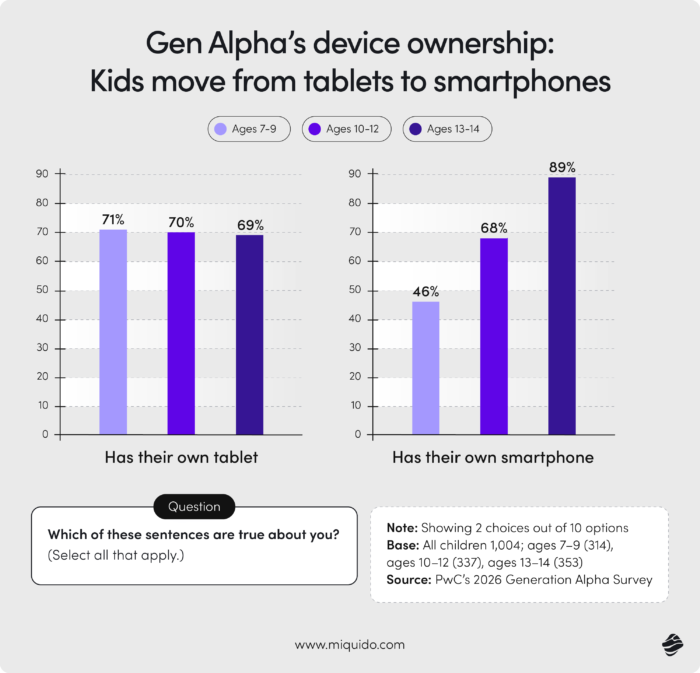
These statistics uncover a clear tendency: businesses must adopt a mobile-first strategy to attract and maintain Gen Z and Alpha users. Soon, startup and enterprise strategy might drift towards mobile-only, as mobile-first audiences start being a majority in the overall target group.
While mobile becomes an universal touchpoint, desktop-centric legacy products are facing a terminal decline in user acquisition. This unavoidable transition might be smoother with cross-platform frameworks, allowing companies to establish mobile as their key growth channel with one single codebase, and thus, faster and likely cheaper.
Why mobile holds increasing potential for business growth
For enterprises, mobile apps are evolving from simple tools into sophisticated engines for loyalty, data collection, and high-stakes security.
- Brands are increasingly using mobile apps to unify data streams and maximize the long-term value of each customer. Brands leverage mobile apps and unified data collection to increase customer lifetime value (Braze, 2026).
- While mobile app downloads and adoption are high, businesses face a massive hurdle in retention, as users frequently purge apps that do not offer immediate value. A study found that consumers are willing to download mobile travel apps but delete approximately 50% of them from their devices (PLOS ONE, 2021).
- The survival of an app depends less on a "digital mandate" and more on how intuitive and useful the interface feels to the end user. A ScienceDirect study identified application utility and user interface structure as the primary drivers of continued intention to use (ScienceDirect, 2022).
- Native mobile environments offer a structurally more secure platform for sensitive transactions than standard web browsers. Mobile browsers introduce distinct and measurable privacy and security risks not present in native app environments (ACM Conference on Data and Application Security, 2023).
- Modern users demand the ability to solve problems independently through mobile interfaces, driving the growth of self-service features. Users are increasingly seeking autonomy and self-service functions, making mobile the primary tool for independence. 60% of users prefer handling simple issues themselves rather than talking to an agent, while 46% feel frustrated when self-service options are missing. (Miquido, 2025).
These statistics highlight that simply "having an app" is no longer a business advantage; the focus has shifted to high-stakes utility and trust. In 2026, a mobile app is the most effective "secure vault" for a brand’s relationship with its customers, offering privacy and security controls that mobile web simply cannot match. This makes it the mandatory choice for FinTech, Healthcare, and any industry handling sensitive data.
However, business owners must beware of the "forced adoption trap." While users are willing to download an app to access a service, they will delete it within seconds if it feels like a burden rather than a tool.
One of the ways to pivot this tendency is to turn the product strategy toward radical autonomy. By integrating robust self-service features and intuitive mobile UI apps design, businesses can transform their app from a temporary download into a persistent, high-LTV engagement layer that reduces operational costs while boosting user loyalty.

Who are the regional leaders of mobile app development?
The supply side of mobile development shows a strong concentration of talent in Europe and the USA, with a growing trend toward service hybridization and AI specialization.
- Among the top 100 mobile app development companies, Europe currently holds the largest share of the market's elite providers. 46% of top-rated mobile app development companies are based in Europe, with high concentrations in Poland and Ukraine (Clutch, 2025).
- The United States remains a massive hub for mobile innovation, particularly for high-end strategy and engineering. 31% of the world's top-rated mobile development firms are based in the United States, primarily in tech hubs like California and New York (Clutch, 2025).
- Asian development centers continue to command a significant portion of the global market, driven by scaling power in India and Vietnam. 17% of leading development firms are based in Asia, primarily across India, Vietnam, and Malaysia (Clutch, 2025).
- Most top-tier development firms have evolved into hybrid providers, offering web and custom software alongside mobile expertise. 82% of these top-rated companies provide Web Development or Custom Software as a secondary service, typically accounting for 20-40% of their business (Clutch, 2025).
- AI development has rapidly become a core offering for nearly a quarter of the world's leading app agencies. Approximately 22% of the top companies already explicitly list AI Development or Generative AI as a core service line (Clutch, 2025).
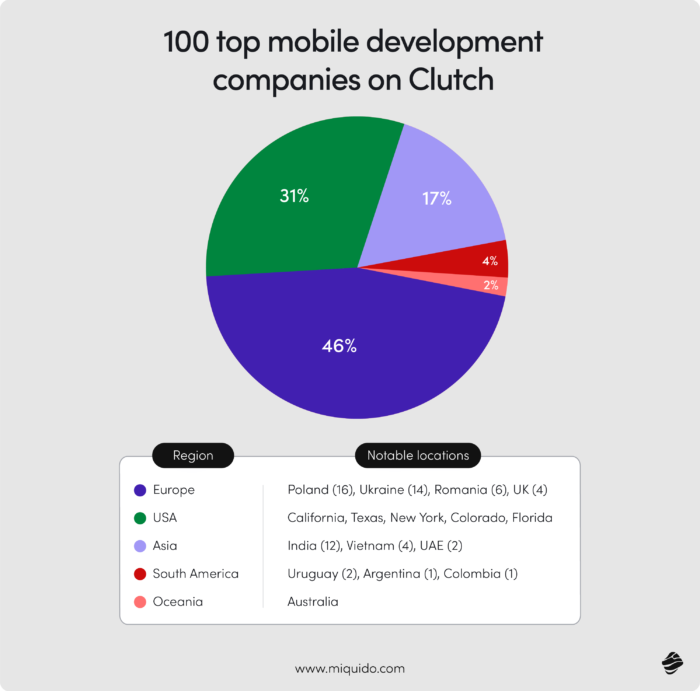
Europe (specifically Poland and Ukraine) offers the highest density of top-rated providers, making it a "sweet spot" for outsourced innovation. Some Central European companies, like Miquido, focus strongly on cross-platform development, enabling companies to deploy apps with native performance on multiple platforms at a fraction of what native mobile app development process costs.
"Design-Centric" agencies (only 18% of the market) are a rarity; there is a high demand for providers that prioritize UX/UI over pure code. This demand will continue to increase as the coding process continues to be automatized by the improving AI tools.
To reduce time to market and app development costs, buyers should look for "hybrid" providers, as pure mobile-only providers are becoming rare and may lack the cross-platform perspective needed for 2026.
Key trends in mobile app development for 2026
The market is shifting toward super-apps, Value-Added Services (VAS), and the deep integration of agentic AI and on-device AI.
- Payment platforms are evolving into comprehensive profit engines by offering services far beyond simple transactions. Value-added services are repositioning payment platforms from commodity rails into profit engines (Deloitte, 2025).
- Multi-service integration is now a statistically proven driver of user loyalty and platform "stickiness." Multi-service integration is a statistically significant predictor of user adoption and platform stickiness (MDPI, 2025).
- Retailers are utilizing AI and facial recognition to eliminate friction points like checkout lines entirely, encouraging in-app purchases. Retailers are deploying autonomous checkout stores and facial recognition to increase throughput and convenience (Globant, 2026).
- Rising acquisition costs are driving developers to use the web as a cheaper "entry point" before converting users to native apps. Web-to-app user acquisition spend reached $12.2 billion in 2024, with web fees averaging just 6% (Business of Apps, 2024).
- A massive wave of enterprise applications is about to be upgraded with AI agents capable of performing complex tasks. Gartner predicts 40% of enterprise applications will include integrated task-specific AI agents by 2026 (Gartner, 2025).
The trends for 2026 point toward a new era, where AI agents and super apps dominate the ecosystem. For business owners, this means the single-purpose applications might be losing relevance. The future belongs to platforms that offer Value-Added Services (VAS), turning a simple app into an indispensable hub for multiple daily needs.
The biggest operational shift will be the move from chatbots to agentic AI. Businesses should prepare to integrate agents that don't just "chat" but actually execute tasks autonomously within the app. Furthermore, as privacy laws tighten, the transition to on-device AI becomes the primary way to provide high-speed AI features while keeping data off the cloud.
To survive rising acquisition costs, smart businesses will use the "Web-to-App" funnel: capture the user cheaply on the web, then migrate them to the app for the high-performance, AI-driven experience that builds long-term value.
Key technology shifts in mobile app development in 2026
As the mobile landscape matures, the focus of development has shifted from simply "building an app" to engineering resilient, automated, and secure ecosystems. This involves a transition toward high-performance cross-platform frameworks and the integration of sophisticated AI that lives directly on the device.
Modernizing the mobile stack: Shift to cross-platform & automation
To keep pace with rapid market demands, enterprises are moving away from fragmented native development in favor of unified, modular architectures.
- Developer preferences have shifted decisively toward versatile frameworks that allow for a single codebase across multiple platforms without sacrificing performance. According to Statista’s 2023 global developer survey, Flutter grew from 30% adoption in 2019 to 46% in 2023, overtaking React Native as the most widely used cross-platform mobile framework (Statista, 2023).
- Enterprise-scale mobile teams are proving that incremental migration to these modern frameworks results in drastic improvements to developer productivity. Nubank reported that after adopting Flutter, their average time for a pull request (PR) to merge dropped from over 70 minutes on native platforms to just 9.9 minutes (Nubank, 2021).
- The push for modularity allows businesses to modernize legacy mobile products piece-by-piece rather than through risky, total rewrites. Gartner's 2026 report highlights modular, specialized agent architectures as a key imperative to boost efficiency and reduce risk by reusing proven solutions (Gartner, 2025).
- As network and backend activities become increasingly automated, the pressure on mobile teams to modernize front-end legacy systems has reached a critical point. Gartner predicts that by 2026, 30% of enterprises will automate more than half of their network activities, creating urgent demand for low-disruption migration approaches (Gartner, 2024).
On-device AI: The edge computing imperative
To solve for latency and data sovereignty, mobile applications are increasingly processing AI workloads locally rather than relying on the cloud.
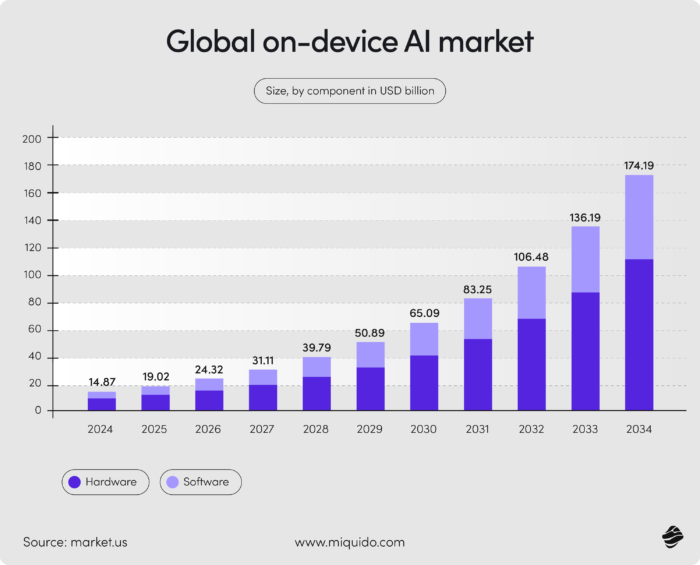
- The explosion in local AI processing is fueled by a massive enterprise need for instant decision-making that bypasses the lag of traditional cloud networks. The global on-device AI market was valued at $10,764.5 million in 2025 and is projected to reach $75,505.9 million by 2033 (Grand View Research, 2025).
- Enterprises are increasingly prioritizing on-premises and on-device deployment to ensure data sovereignty and meet strict security compliance standards. The U.S. on-device AI market stood at $4.97 billion in 2024, with on-premises deployment capturing a 72.1% share (Market.us, 2024).
- Advances in specialized AI chipsets are finally allowing smartphones to handle complex multimodal tasks—like real-time translation—entirely offline. The global on-device AI market is projected to grow to $17.30 billion by 2032, with growth explicitly attributed to enhanced privacy (Markets and Data, 2024).
The security crisis: Guardrails and AI governance
As mobile apps integrate Large Language Models (LLMs), the industry is grappling with a massive failure rate due to insufficient security and integration frameworks.
- Most enterprise AI initiatives are currently failing because they lack the necessary workflow-adapted guardrails and compliance alignment. MIT research reveals a 95% failure rate for enterprise generative AI implementations, noting that vendor-partnered builds succeed twice as often as internal ones (Fortune/MIT, 2025).
- Current manual oversight is no longer enough to manage the complexity of AI agents, leading to the rise of autonomous security layers. Gartner predicts that by 2028, 40% of CIOs will demand "Guardian Agents" to autonomously track and contain AI agent actions (Gartner, 2024).
- As AI models become more domain-specific, the urgency for specialized security platforms to protect these assets has become a top priority. Over 50% of enterprises are expected to adopt AI security platforms by 2028 to manage harder-to-control LLM deployments (Gartner, 2025).
- Developers must now defend against a new catalog of mobile-specific risks, including prompt injection and supply chain vulnerabilities in AI models. The OWASP Top 10 for LLM Applications identifies that compromised components or datasets directly cause data breaches and system failures (OWASP, 2025).
The technological data for 2026 reveals a move away from "experimental" AI and fragmented coding toward industrial-grade stability and edge-based intelligence. The massive 95% failure rate in internal AI pilots is a wake-up call: the "move fast and break things" era has been replaced by a "secure and scale" mandate. For business owners, the goal shifts from just shipping features to ensuring those features are compliant, high-performance, and platform-agnostic.
To stay competitive, decision-makers must implement these core adaptations:
- Hybrid modernization over total rewrites: Use the "Add-to-App" approach with Flutter to inject modern cross-platform modules into your existing legacy codebase. This isn't just a tech choice—it’s a business efficiency play, as evidenced by the 7x reduction in merge times seen at companies like Nubank. Faster development cycles directly equate to lower burn rates and quicker market responses.
- Transition to the edge (On-device AI): If your product handles sensitive health, financial, or corporate data, move your AI workloads from the cloud to the device. By 2033, this market will reach $75 billion for a reason: Privacy-by-Design is becoming a legal and consumer requirement. On-device AI eliminates cloud latency and provides the data sovereignty that 72% of enterprises now demand.
- The "Guardian" security layer: With the rise of autonomous agents, traditional guardrails are no longer sufficient. Businesses should prioritize building or integrating "Guardian Agents", autonomous monitors that track AI actions in real-time. This is the only way to mitigate the top-tier risks identified by OWASP, such as prompt injection and data leakage.
- Mitigating the 67% failure risk: The data is clear—internal AI builds without specialized oversight are statistically likely to fail. To ensure a successful rollout, partner with an experienced mobile app development company that has proven expertise in workflow-adapted guardrails and domain-specific LLM integration.
Mobile app store dynamics: Quality purges and high stakes
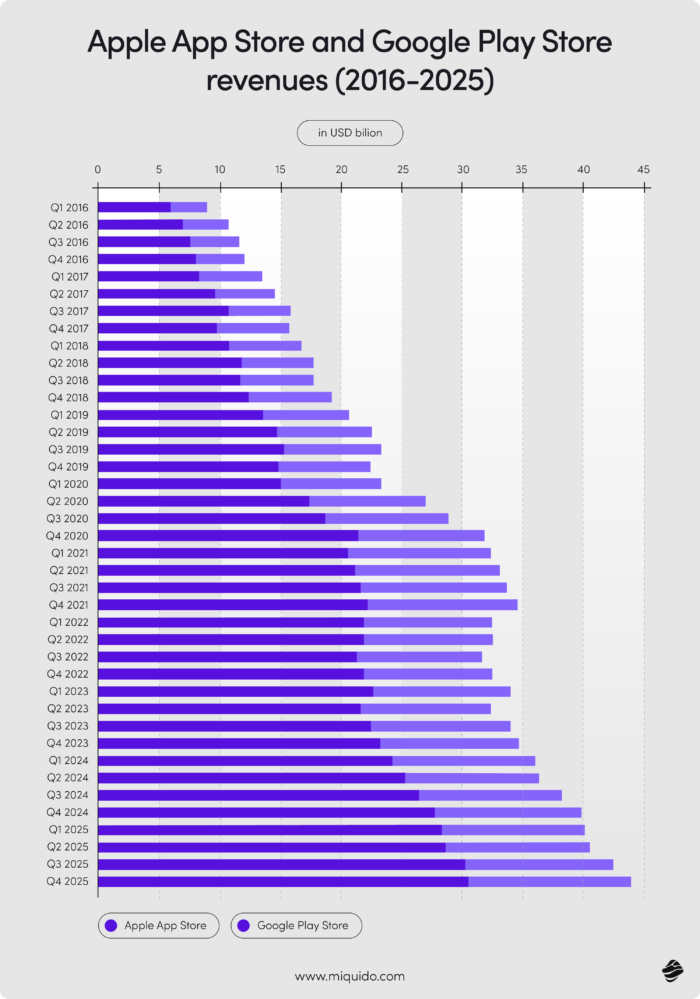
The 2026 app store environment is defined by a "quality over quantity" philosophy, with Apple dominating the monetization landscape.
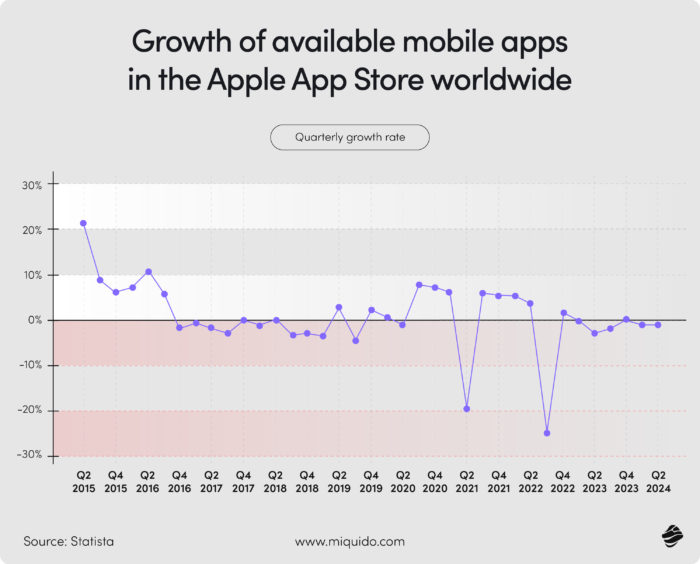
- The gap in spending between Apple and Google users continues to widen, with Apple generating more than double the revenue. In 2025, the Apple App Store generated $117 billion, more than double Google Play’s $49.2 billion (Business of Apps, 2025).
- Google has slashed its total app count by over 50% in an aggressive move to clean up outdated and low-quality software. Google Play reached a peak of 3.6 million apps in 2017; by 2025, that number plummeted to 1.58 million (Business of Apps, 2025).
- Regulatory bodies are actively fining major mobile app platforms for anti-competitive practices that limit developer freedom. The European Commission fined Apple €500 million in April 2025 for non-compliance with DMA rules (European Parliament, 2025).
- A major shift in developer economics is occurring as companies gain the legal right to steer users to cheaper off-store channels. Bruegel documents that the standard 30% fee is the target of DMA Article 5(5), permitting off-store purchase channels (Bruegel, 2024).
Mobile app monetization shift: Precision subscription strategies
- Subscription-based apps are finding that a "hard paywall" often yields a more loyal and valuable user base than the traditional freemium model. According to RevenueCat's State of Subscription Apps 2025, monthly retention under a hard paywall outperforms freemium apps, with a median of 12.8% vs. 9.3% (RevenueCat, 2025).
- The dominance of short-term billing cycles is accelerating, with weekly plans now acting as the primary engine for mobile revenue growth. Adapty's 2026 report reveals that weekly plans generate 55.5% of all app revenue, up significantly from 43.3% in 2023 (Adapty via RevenueCat, 2025).
- Strategically combining a weekly plan with a free trial has emerged as the most effective lever for maximizing a user's long-term financial value. A weekly+trial configuration delivers a 12-month LTV of $49.27—a staggering 636% increase over weekly plans offered without a trial (Adapty via RevenueCat, 2025).
- In high-utility categories like Lifestyle and Productivity, the architecture of the trial period is now more important than the presence of the paywall itself. Data shows that users who start with a trial have a Lifetime Value (LTV) up to 64% higher than those who do not (Adapty, 2025).
- Modern users treat app trials as impulsive "test drives," meaning the window to prove an app’s worth has shrunk to the very first session. RevenueCat’s 2026 analysis finds that the window to demonstrate utility has collapsed, making first-session value delivery the single most critical monetization variable (RevenueCat, 2026).
- The financial gap between apps with optimized monetization and those without is reaching extreme levels of disparity. The top 5% of newly launched apps now generate over 400x more revenue than the bottom 25% after their first year (Phiture, 2025).
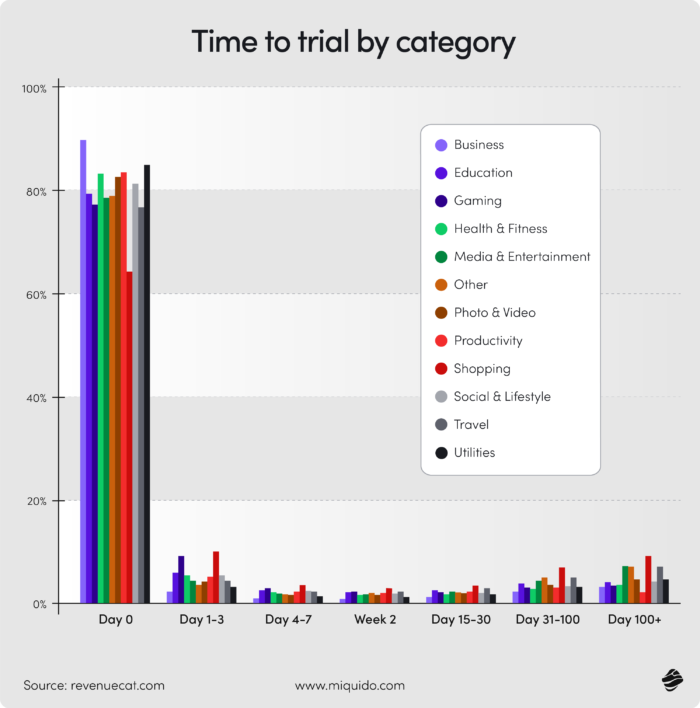
The 2025-2026 data signals a transition from the "discovery era" to the "retention and optimization era." With Google and Apple aggressively purging nearly 50% of low-quality inventory, the barrier to entry is no longer just "getting approved", but surviving the first 24 hours. The 400x revenue gap between top-tier and bottom-tier apps proves that success is now a binary: you are either an optimized profit engine or you are invisible.
For business owners, this means shifting focus toward these key adaptations:
- The "first session" is the only session: Since users now treat trials as impulsive "test drives," your subscription revenue depends entirely on delivering immediate value within the first 10 minutes. If the "Aha!" moment is buried behind a long onboarding, the user will cancel before the first day ends.
- Hard paywalls as app monetization strategies for high-intent growth: The data debunking the "freemium safety net" is a game-changer. Switching to a hard paywall can increase your conversion rate by 5x, filtering for committed users who are 37% more likely to stay long-term.
- Dynamic billing cycles: Adopting a weekly+trial configuration is currently the single most effective way to maximize 12-month LTV. It provides the quick cash flow needed for aggressive user acquisition while acting as a high-conversion entry point.
- Regulatory arbitrage: Use the new EU and US regulations to your advantage. By steering high-value users to web-based payment flows or alternative stores, you can bypass the "30% App Store tax," directly increasing your margins for reinvestment into product quality.
Turn these mobile app stats into safe guardrails
As the data for 2026 clearly shows, the line between a market leader and a struggling product is drawn by the ability to adapt to on-device AI, cross-platform efficiency, and sophisticated monetization. Navigating this shifting landscape requires more than just technical skill; it requires a partner who has been at the forefront of these transitions. At Miquido, we don't just track these trends, but build the solutions that define them.
With over 100 million users worldwide interacting with our mobile solutions, we possess a unique, data-backed perspective on what drives sustained engagement and global scale. Whether it’s modernizing legacy monoliths for industry giants like Skyscanner or engineering high-performance Flutter apps for fast-growing startups, our "business-first" approach ensures that every line of code serves your ROI. Let us turn these 2026 insights into your next competitive advantage.

Top AI innovations delivered monthly!
The administrator of your personal data is Miquido sp. z o.o. sp.k., with its ... registered office in Kraków at Zabłocie 43A, 30 - 701. We process the provided information in order to send you a newsletter. The basis for processing of your data is your consent and Miquido’s legitimate interest.You may withdraw your consent at any time by contacting us at marketing@miquido.com. You have the right to object, the right to access your data, the right to request rectification, deletion or restriction of data processing. For detailed information on the processing of your personal data, please see Privacy Policy.


![[header] mobile app security best practices 10 essential tips for 2026](https://www.miquido.com/wp-content/uploads/2026/03/header-mobile-app-security-best-practices-10-essential-tips-for-2026-2048x1365.jpg.webp)
![[header] top 5 use cases for autonomous delivery in foodtech today](https://www.miquido.com/wp-content/uploads/2025/08/header-top-5-use-cases-for-autonomous-delivery-in-foodtech-today.jpg)